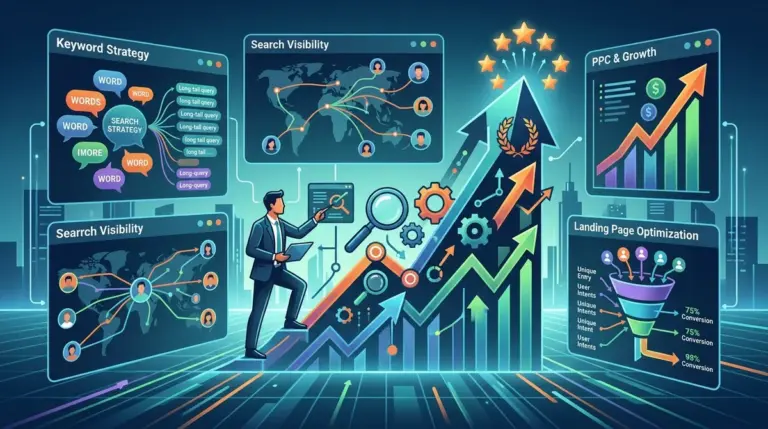
Most marketing departments treat SEO like a slot machine: they pull the lever of content production and hope for a jackpot. This erratic approach is why SEO is often the first budget line item cut during a downturn. To transform organic search from a speculative gamble into a predictable growth channel, you must stop optimizing for "visibility" and start engineering for revenue. This requires a shift from creative-led blogging to data-led asset deployment based on search intent, conversion probability, and technical resilience.
Reverse-Engineering the Revenue Target
Predictability begins with a spreadsheet, not a keyword tool. If your goal is to generate $500,000 in new monthly recurring revenue (MRR) from organic search, you must work backward through your funnel metrics. If your average contract value is $10,000 and your lead-to-close rate is 10%, you need 500 qualified leads. If your landing pages convert at 2%, you need 25,000 monthly visitors to high-intent pages.
Best for: Marketing Directors and CFOs who need to justify SEO spend against paid media performance.
By defining these requirements, you stop chasing high-volume, low-intent "vanity" keywords that inflate traffic without impacting the bottom line. Instead, you prioritize "Buy" and "Investigate" intent keywords where the Cost Per Click (CPC) in Google Ads is highest, as these indicate proven commercial value.
The Content Velocity and Cluster Framework
One-off articles rarely move the needle in competitive verticals. Predictable growth relies on topical authority, which is earned by covering every facet of a specific subject. This "cluster" approach signals to search engines that your domain is a definitive resource, reducing the time it takes for new pages to reach the first page of results.
Building High-Efficiency Content Clusters
A cluster consists of a central pillar page—usually a broad, high-volume term—and multiple supporting sub-pages that target long-tail, specific queries. This structure distributes internal link equity and keeps users within your ecosystem longer.
- Pillar Page: Comprehensive guide to "Enterprise CRM."
- Supporting Asset A: "CRM integration for manufacturing firms."
- Supporting Asset B: "Hidden costs of legacy CRM migration."
- Supporting Asset C: "Comparison: Salesforce vs. HubSpot for mid-market."
To maintain predictability, your content production must follow a strict editorial cadence. Aiming for "quality over quantity" is a false dichotomy; high-growth agencies achieve both by using structured briefs that dictate header hierarchy, internal linking targets, and specific semantic entities that must be included to satisfy NLP (Natural Language Processing) requirements.
Warning: Avoid the "Freshness Trap." Many teams waste resources updating old blog posts that have no path to conversion. Only refresh content if it currently ranks on page two or three for high-intent terms, or if the factual accuracy has decayed enough to hurt your brand authority.
Hard-Coding Technical Stability
You cannot build a predictable growth channel on a fractured foundation. Technical SEO is the "floor" of your performance; if your site cannot be efficiently crawled or indexed, your content investment is effectively zeroed out. Predictability requires proactive monitoring of two specific areas: crawl budget and Core Web Vitals.
Large-scale sites often suffer from "index bloat"—thousands of low-value pages (like filter parameters or old tag pages) that consume Google’s attention. By pruning these and using robots.txt directives to focus crawlers on revenue-generating URLs, you ensure that your most important updates are processed and ranked faster. Furthermore, meeting the "Good" threshold for LCP (Largest Contentful Paint) and CLS (Cumulative Layout Shift) is no longer optional; it is a baseline requirement for maintaining rankings during core algorithm updates.
Attribution and the Feedback Loop
The biggest barrier to predictable SEO is the lack of a feedback loop. In PPC, you know within 48 hours if a campaign is failing. In SEO, the lag time can be months. To bridge this gap, use leading indicators rather than lagging indicators.
Leading Indicators:
- Increase in impressions for target keyword clusters.
- Improved average position for "seed" keywords.
- Growth in the number of pages receiving at least one organic click.
Lagging Indicators:
- Total organic conversions.
- Domain Rating (DR) or Authority Score.
- Total monthly organic sessions.
By monitoring leading indicators weekly, you can identify which clusters are gaining traction and double down on those topics before the final revenue results are even visible. This allows for mid-quarter pivots that keep growth on an upward trajectory.
Operationalizing the Strategy
To turn these concepts into a repeatable process, your team must move away from "SEO tasks" and toward "SEO sprints." Start by auditing your existing content to identify the "Striking Distance" opportunities—keywords ranking in positions 11-20. These are your fastest wins. Simultaneously, launch a new content cluster every 30 days, supported by a dedicated internal linking campaign. Document the results of each sprint to refine your "cost per lead" calculation for organic search. When you can accurately predict that $X investment in content and technical debt reduction will yield $Y in pipeline value within six months, SEO stops being a mystery and becomes your most reliable growth engine.
Frequently Asked Questions
How long does it take for SEO to become predictable?
Typically, it takes 6 to 9 months of consistent execution to gather enough historical data to forecast future performance. During the first 90 days, focus on technical health and "striking distance" keywords to generate early momentum.
Which metrics matter most for ROI?
Ignore total traffic. Focus on "Assisted Conversions" and "Organic Pipeline Value." Use your CRM to track how many leads that originated from organic search eventually closed, then calculate your Organic CAC (Customer Acquisition Cost).
Should I prioritize backlinks or content?
Content is the vehicle, and backlinks are the fuel. Without high-quality, intent-matched content, even the strongest backlink profile won't convert. Prioritize building a solid topical cluster first, then use targeted outreach to earn links to those specific pillar pages.
How do I handle sudden algorithm updates?
Algorithm volatility is only a threat to sites relying on "gray hat" tactics or thin content. If your growth is built on technical excellence and genuine topical authority, updates often result in a net gain as lower-quality competitors are filtered out.