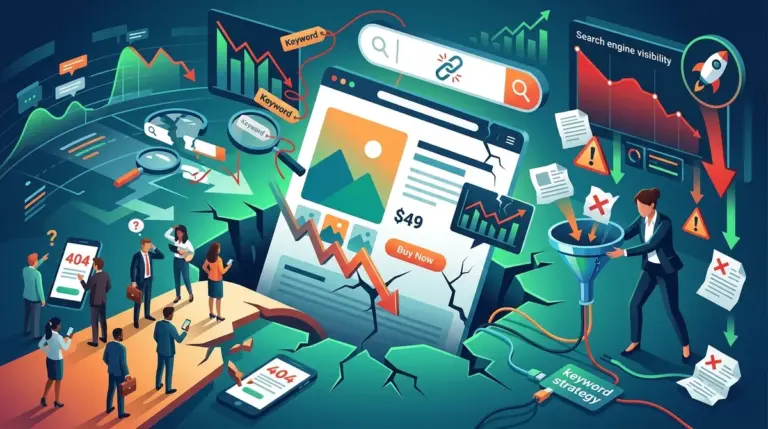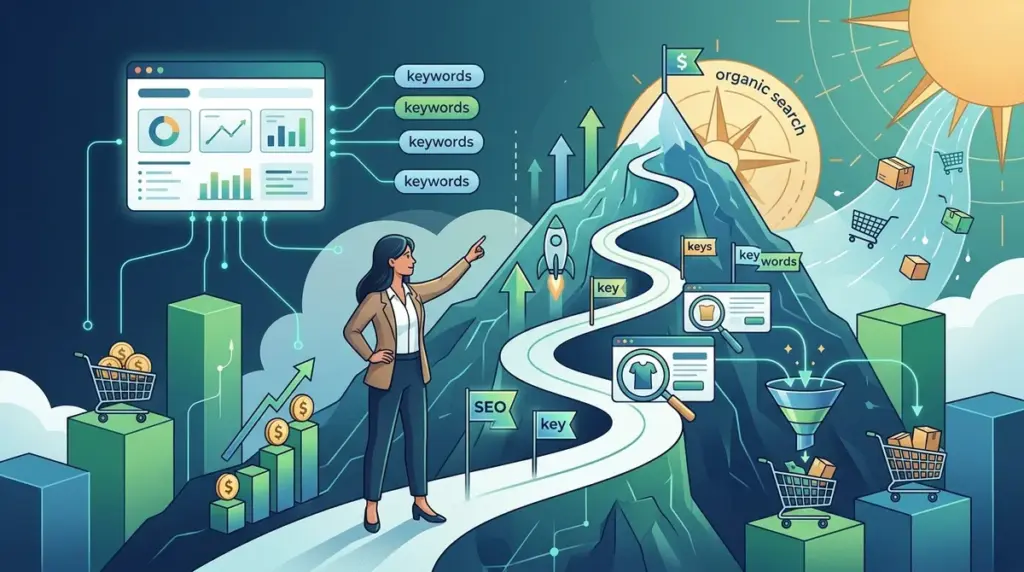
Ecommerce SEO is often treated as a volume game, but chasing raw traffic is a high-cost distraction if that traffic doesn't convert into transactions. As customer acquisition costs (CAC) on paid social and search platforms continue to climb, organic search remains the most viable channel for sustainable margin growth. Growing organic revenue requires a shift from generic keyword targeting to a precision-based model that prioritizes technical crawl efficiency and high-intent landing page optimization.
Best for: Mid-to-large scale ecommerce stores with over 500 SKUs looking to recapture market share from aggregators and direct competitors.
Solving the Faceted Navigation Crawl Budget Leak
The most common technical failure in ecommerce is an unoptimized faceted navigation system. While filters for size, color, and price are essential for user experience, they generate thousands of near-duplicate URLs that can trap search engine crawlers. If Google spends 80% of its crawl budget on low-value filtered pages, your primary category and product pages will suffer from delayed indexing and poor ranking stability.
To fix this, implement a strict crawling logic. Use AJAX for filters to prevent the generation of new URLs for every click, or utilize the Robots.txt file to disallow crawling of specific parameter strings. However, the most effective method for preserving equity is the strategic use of canonical tags. Ensure that filtered views point back to the main category URL unless those filters represent a high-volume search term (e.g., "Men's Blue Running Shoes") that warrants a unique, indexable page.
Warning: Avoid using "Noindex, Follow" on paginated category pages as a long-term solution. Over time, Google may treat long-term "Noindex" pages as "Nofollow," effectively cutting off the flow of internal link equity to the products listed on those pages.
Prioritizing Category Pages Over Individual SKUs
In the hierarchy of ecommerce revenue, category pages (PLPs) almost always outperform individual product pages (PDPs). This is because category-level keywords typically have higher search volume and capture users who are still in the "consideration" phase but ready to buy. A user searching for "ergonomic office chairs" is a more valuable target for organic growth than a user searching for a specific, obscure model number that may go out of stock next month.
Keyword Mapping for Commercial Intent
Stop targeting informational keywords with your category pages. Instead, focus on modifiers that signal a readiness to purchase. This includes terms like "best," "affordable," "professional-grade," or "bulk." Map these keywords to your H1 tags, meta titles, and the introductory copy on the category page. The goal is to satisfy the "transactional" intent immediately upon the page loading.
- Internal Linking: Use descriptive anchor text from blog posts to category pages to build topical authority.
- Breadcrumbs: Implement JSON-LD breadcrumb schema to improve SERP click-through rates and help Google understand your site’s hierarchy.
- Product Density: Ensure your top-performing categories have enough products to satisfy user intent; a category with only two items rarely ranks on the first page.
Scaling Unique Product Descriptions Without Content Thinness
Google’s helpful content guidelines penalize sites that rely on manufacturer-provided descriptions. If 50 other retailers are using the same boilerplate text for a pair of sneakers, your page offers zero unique value. To grow organic revenue, you must differentiate your PDPs. Focus on "problem-solution" copy: explain what the product does, who it is for, and why it is superior to alternatives.
If you have thousands of SKUs, prioritize your top 20% of revenue-generating products for manual rewrites. For the remaining 80%, use structured data and user-generated content (UGC) like reviews and Q&A sections to add unique text to the page without requiring a massive copywriting budget. Reviews are particularly effective because they naturally contain long-tail keywords that customers actually use when searching for products.
Technical Schema for Enhanced Search Real Estate
To increase your organic click-through rate (CTR), you must win the "rich result" battle. Ecommerce sites should implement Product Schema (JSON-LD) on every PDP. This allows Google to display price, availability, and star ratings directly in the search results. A result with a 4.5-star rating and a "In Stock" label will almost always out-convert a higher-ranking result that lacks that data.
Furthermore, implement "Organization" and "Local Business" schema if you have physical storefronts. This creates a "Knowledge Graph" presence that builds brand trust. For category pages, use "CollectionPage" schema to help search engines identify the page as a curated list of products rather than a single article or product.
Building a Sustainable Backlink Profile for Ecom
Link building for ecommerce is notoriously difficult because few people want to link to a commercial product page. To grow your authority, focus on "Middle of the Funnel" (MOFU) content that provides genuine utility. Create buying guides, comparison charts, or "how-to" manuals that naturally earn links from enthusiasts and industry publications.
Once you earn a link to a high-value guide, use internal linking to pass that "link juice" down to your category and product pages. Another effective tactic is "Broken Link Building" within your niche. Find defunct competitors or out-of-stock products on other sites and reach out to the linking domains to suggest your active product as a superior replacement.
Immediate Steps to Audit Your Organic Revenue Pipeline
To turn these strategies into revenue, begin with a gap analysis. Compare your current rankings for high-intent category terms against your top three competitors. If they are outranking you, it is likely due to a combination of superior internal linking and more comprehensive category-level content.
Next, audit your "Add to Cart" events by traffic source. If your organic traffic has a high bounce rate on mobile, your LCP (Largest Contentful Paint) is likely too slow. Ecommerce shoppers are impatient; every 100ms of latency can result in a 1% to 5% drop in conversion. Use a CDN and optimize your image payloads using WebP formats to ensure your technical SEO doesn't undermine your content efforts.
Finally, monitor your "Out of Stock" (OOS) strategy. Never delete a URL for a product that is temporarily OOS. Instead, keep the page live, provide a "Notify Me" option, and suggest related products. This preserves the page's SEO equity while keeping the user within your sales funnel.
Frequently Asked Questions
Should I delete out-of-stock product pages?
No. Deleting the page results in a 404 error and loss of all accumulated backlink equity. If the product is gone forever, use a 301 redirect to the most relevant category page. If it is temporary, keep the page live but remove the "Add to Cart" button to avoid frustrating users.
How long does it take to see revenue growth from ecommerce SEO?
Technical fixes, such as resolving crawl loops or fixing schema errors, can show results within weeks. However, content-led growth and authority building typically take 3 to 6 months to manifest in significant rank improvements for competitive commercial terms.
Is it better to rank a product page or a category page?
Category pages are generally better for revenue because they are more resilient to inventory changes and capture broader search intent. Product pages are better for very specific, long-tail queries where the user knows exactly what model or SKU they want.
Does site speed actually impact SEO rankings?
Yes. Core Web Vitals are a confirmed ranking factor. More importantly, site speed is a conversion factor. Even if you rank #1, a slow-loading page will cause users to bounce back to the SERP, which eventually signals to Google that your page is not a good result for that query.