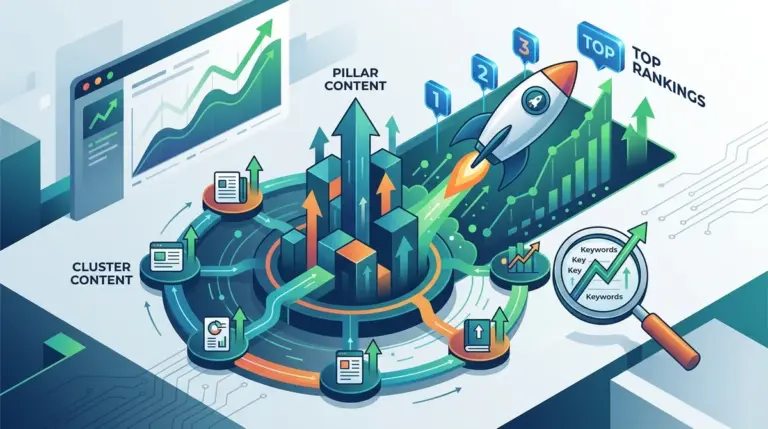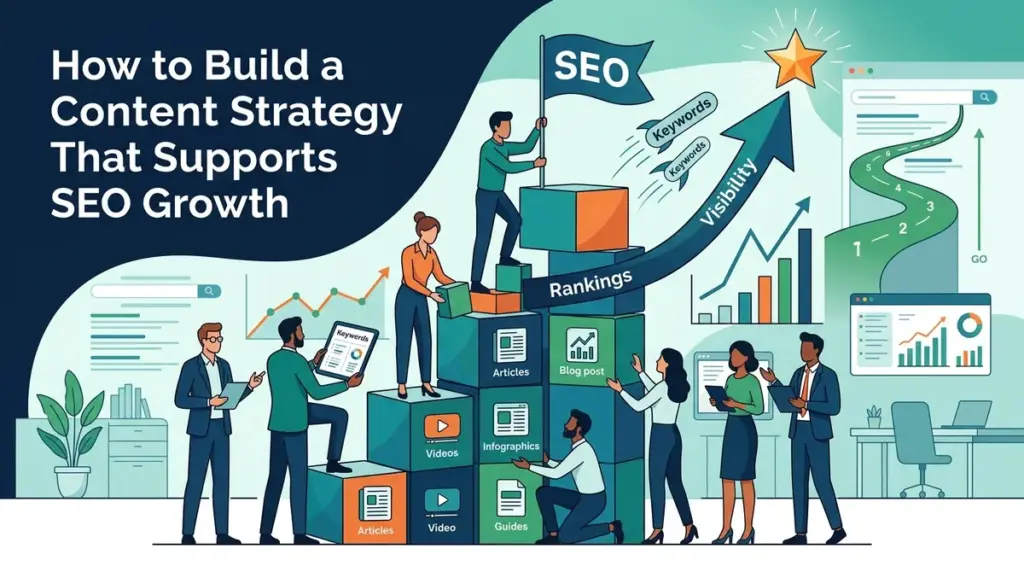
Most content strategies fail because they prioritize volume over velocity. Producing three blog posts a week means nothing if those assets target keywords with no commercial intent or, worse, compete with existing pages on your own site. A high-performance SEO content strategy functions as a capital investment: it requires a clear understanding of searcher intent, a technical framework for internal linking, and a relentless focus on topics that drive revenue, not just vanity metrics like raw sessions. A high-performance SEO content strategy functions as a capital investment: it requires a clear understanding of searcher intent, a technical framework for internal linking, and a relentless focus on topics that drive revenue, not just vanity metrics like raw sessions. Building out topic clusters is key to this internal linking strategy.
Mapping Search Intent to the Marketing Funnel
SEO content is often misclassified as a "top-of-funnel" activity. This is a tactical error. To support growth, your strategy must address the entire user journey. If you only target broad, informational queries, you will generate traffic that never converts. If you only target "buy now" keywords, you will face massive CPC-driven competition and high acquisition costs.
Primary Objective: Aligning content types with specific stages of the buyer's journey to ensure a balanced lead flow.
Informational Intent: Capturing Awareness
Target "how-to" and "what is" queries to establish authority. These pages should be long-form, data-rich, and designed to earn backlinks. They are your primary vehicles for building domain authority, which then flows to your commercial pages through strategic internal linking.
Commercial and Transactional Intent: Driving Revenue
These are your "Best [Service] in [City]" or "[Product A] vs [Product B]" pages. These require high-converting copy, clear calls-to-action (CTAs), and schema markup to capture rich snippets. The goal here is immediate lead generation or sales.
Auditing for Content Decay and Cannibalization
Before creating new assets, you must evaluate what is already live. Many sites suffer from "keyword cannibalization," where multiple pages compete for the same search term, diluting the ranking power of both. A content audit identifies these overlaps and highlights "striking distance" opportunities—pages ranking in positions 4 through 10 that require minimal optimization to move into the top three spots.
Warning: Never delete underperforming content without checking its backlink profile. A page with zero traffic may still be passing significant link equity to your site's more important pages. If you must remove it, always implement a 301 redirect to the most relevant active URL.
- Content Pruning: Consolidate thin pages into a single, comprehensive "Power Page."
- Refresh Cycles: Update statistics, screenshots, and internal links on high-traffic posts every 6 to 12 months to maintain freshness scores.
- Internal Link Optimization: Use descriptive anchor text to signal to crawlers which page is the primary authority for a specific topic.
The Cluster Model: Building Topical Authority
Search engines no longer rank isolated keywords; they rank topics. To dominate a niche, you must build "Topic Clusters." This involves creating a central "Pillar Page" that provides a broad overview of a subject, supported by multiple "Spoke" articles that dive deep into specific sub-topics.
Best for: Improving crawl efficiency and signaling deep expertise to search engine algorithms.
A pillar page on "B2B Lead Generation" might link to spoke articles on "LinkedIn Ad Strategies," "Cold Email Sequences," and "Lead Magnet Design." This structure keeps users on your site longer and creates a logical hierarchy that search engine bots can easily navigate. Every spoke article must link back to the pillar page, reinforcing its status as the primary resource.
Engineering Content for Distribution and Backlinks
If you publish content and wait for it to rank, you are leaving growth to chance. A modern SEO strategy incorporates "linkable assets"—content specifically designed to be cited by other publishers. This includes original research, proprietary data sets, or complex infographics that simplify difficult concepts.
Content should also be optimized for secondary search engines like YouTube or Pinterest, depending on your niche. Repurposing a high-performing blog post into a video or a series of social media threads increases the "surface area" of your brand in search results, capturing users who prefer different media formats.
Scaling Production Without Diluting Quality
Scaling requires a repeatable workflow. This starts with a standardized Content Brief. A brief should never just be a title and a word count. It must include:
1. Primary and secondary keyword targets.
2. Target search intent (e.g., "Educational/Problem-solving").
3. Competitive analysis (what are the top 3 results doing better?).
4. Specific internal links to include.
5. Required expert quotes or proprietary data points.
By front-loading the research in the brief, you ensure that external writers or internal teams produce assets that meet technical SEO requirements on the first draft, reducing the need for extensive developmental editing.
Immediate Implementation Roadmap
To turn these concepts into a functioning strategy, follow this sequence over the next 30 days:
Week 1: Run a full site crawl to identify technical blockers and pages in "striking distance" (positions 4-10). Prioritize these for immediate updates.
Week 2: Map your existing content to a topic cluster model. Identify gaps where you lack "spoke" content to support your primary "pillar" pages.
Week 3: Develop three high-intent content briefs targeting commercial keywords that your competitors are currently winning. Focus on providing a better user experience (UX) and more current data.
Week 4: Audit your internal linking. Ensure your highest-converting pages are receiving the most internal "link juice" from your high-traffic informational posts.
Content Strategy FAQ
How often should I publish new content for SEO?
Consistency is more important than frequency. It is better to publish one high-quality, 2,000-word guide per month that earns backlinks and rankings than four 500-word posts that fail to provide depth. Focus on "content velocity"—the rate at which you publish high-quality, indexable pages.
Can I use AI to write my SEO content?
AI is a tool for outlining and drafting, not a replacement for expertise. Search engines prioritize "E-E-A-T" (Experience, Expertise, Authoritativeness, and Trustworthiness). AI-generated content often lacks the "Experience" element. Use AI to speed up the process, but always have a human subject matter expert add unique insights and verify facts.
How long does it take for a new content strategy to show results?
For established domains, you may see movement in 4 to 8 weeks. For new domains, it can take 6 to 12 months to build enough topical authority to rank for competitive terms. SEO is a long-term compounding asset, not a quick-fix channel.
What is the most important metric for content success?
While traffic is a leading indicator, "Conversions per Organic Visit" is the ultimate metric. If a page brings in 10,000 visitors but zero leads, it is a failure of intent alignment or CTA placement. Monitor your bounce rate and time-on-page to ensure the content actually satisfies the user's query.