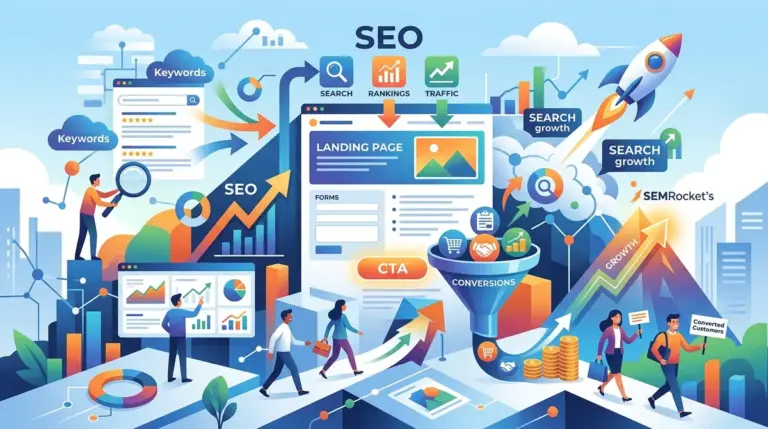
SEO and Conversion Rate Optimization (CRO) are often treated as opposing forces. SEO teams demand more text, more internal links, and long-form guides to satisfy crawlers, while CRO specialists want to strip away distractions, shorten copy, and push users toward a single button. This friction is expensive. If you optimize for conversion by removing contextual keywords, your rankings drop. If you optimize purely for rankings, your traffic bounces because the page feels like an encyclopedia rather than a solution.
The goal is to increase the percentage of organic visitors who take action without degrading the signals that earned the traffic in the first place. This requires a surgical approach to page architecture, intent mapping, and technical execution.
Aligning Keyword Intent with Conversion Mechanics
Most organic conversion failures stem from a mismatch between why a user clicked and what the page asks them to do. A user searching for "how to calculate churn rate" is in an informational mindset; hitting them with a "Schedule a Demo" pop-up immediately results in a bounce. Conversely, a user searching for "best enterprise CRM for fintech" is ready for a trial or a sales call.
Mapping the Funnel to the Page Layout
For informational keywords, the conversion should be a low-friction "micro-conversion," such as a newsletter signup or a gated template. For transactional keywords, the CTA must be the primary visual focus. Best for: Reducing bounce rates on high-volume blog posts by offering relevant lead magnets instead of hard sales pitches.
Identifying Information Gaps
Analyze the "People Also Ask" boxes for your target keywords. If your page ranks but doesn't convert, you are likely missing a specific detail the user needs to make a decision—such as pricing transparency, integration capabilities, or shipping timelines. Adding this data increases dwell time (a positive SEO signal) while removing the barrier to conversion.
Optimizing Above-the-Fold Real Estate
Google’s Page Layout Algorithm penalizes sites that push content too far down the page to make room for ads or massive hero images. However, from a CRO perspective, your value proposition must be visible immediately. The balance lies in the "Hybrid Header."
Use a concise H1 (or a styled H2 if the H1 is reserved for a more SEO-heavy phrase) that contains your primary keyword but speaks directly to a pain point. Surround this with 50-100 words of high-value introductory text. This satisfies the search engine's need for immediate context while ensuring the user knows they are in the right place.
Warning: Avoid using intrusive interstitials or "welcome mats" that cover the entire screen upon entry. Google classifies these as a negative ranking factor for mobile usability. Instead, use slide-ins or exit-intent overlays that do not obstruct the initial crawl of the page content.
Leveraging Semantic Context in CTAs
Generic buttons like "Click Here" or "Submit" provide zero SEO value and poor conversion incentive. Search engines use the text surrounding a link to understand the destination's relevance. By using descriptive, keyword-rich CTAs, you improve the internal linking profile of your site while telling the user exactly what they get.
- Instead of: "Download Now"
- Use: "Download the 2024 SaaS Benchmarking Report"
- Instead of: "Contact Us"
- Use: "Get a Custom SEO Audit Quote"
This approach creates a "scent of information" that users follow, increasing the click-through rate (CTR) to your bottom-funnel pages.
Technical Safeguards for A/B Testing
Testing different layouts to improve conversion can inadvertently hurt SEO if handled incorrectly. If you are running split tests on high-traffic landing pages, you must ensure Google doesn't see two versions of the same page as duplicate content.
Always use rel="canonical" tags pointing from the variation pages back to the original URL. If the test is long-term, use a 302 (temporary) redirect rather than a 301. This signals to crawlers that the original page is still the authoritative version and should remain in the index while you gather conversion data.
Improving Core Web Vitals to Support Both Goals
Site speed is a rare area where SEO and CRO are perfectly aligned. A one-second delay in mobile load times can decrease conversions by up to 20%. Specifically, focus on Cumulative Layout Shift (CLS). If a user goes to click a button and the page shifts because an image loaded late, they might click the wrong element or leave in frustration. Fixing CLS improves the user experience (CRO) and satisfies Google’s page experience requirements (SEO).
The "Inverted Pyramid" Content Strategy
To keep SEO authority while driving sales, structure your pages using the inverted pyramid model. Place the most critical, conversion-focused information at the top. Follow this with supporting details, data, and social proof. Place the dense, keyword-rich "how-to" or FAQ content toward the bottom. This allows the user to convert early if they are ready, while providing the search engine with the long-form text it needs to rank the page for a variety of long-tail queries.
Execution Checklist for SEO-Friendly CRO
Before launching any conversion-focused update, run through this checklist to ensure you aren't sacrificing visibility for clicks:
- Verify that the primary keyword remains in the first 100 words of the page.
- Ensure that new CTA buttons or forms do not push the main body text below the fold on mobile devices.
- Check that all images used for social proof (logos, testimonials) have descriptive alt text.
- Confirm that any "hidden" content, such as accordions used to save space, is still accessible in the HTML source for crawlers.
- Test the page load speed after adding high-resolution conversion elements like video testimonials.
Audit Your Results and Iterate
Improving organic conversion is not a one-time event. It requires monitoring your Search Console data alongside your conversion tracking. If you see a page’s average position drop after a layout change, you likely removed too much "contextual weight." If positions hold steady but conversions remain flat, your offer likely lacks relevance to the search intent. The most successful sites treat their high-ranking pages as living assets, constantly refining the balance between satisfying the algorithm and closing the sale.
Frequently Asked Questions
Does removing text to improve design hurt my rankings?
It can. If the text you remove contains primary or secondary keywords that help Google understand the page's topic, you may see a decline. Instead of removing text, consider moving it lower on the page or using UI elements like "Read More" toggles that keep the text in the HTML while cleaning up the visual design.
Will a high bounce rate hurt my SEO?
Bounce rate itself is not a direct ranking factor, but "pogo-sticking"—when a user clicks your result and immediately returns to the search page—is a signal that your page didn't meet their intent. Improving conversion usually reduces pogo-sticking, which can indirectly help your rankings.
Should I use different pages for PPC and SEO?
Often, yes. PPC landing pages are usually stripped of navigation and external links to maximize conversion, which makes them poor candidates for organic ranking. SEO pages need navigation and internal links to distribute authority. If you need a high-converting page for SEO, use the "Inverted Pyramid" structure mentioned above to satisfy both needs on a single URL.
How do I track which keywords are actually converting?
Use a combination of Google Search Console and a conversion tracking tool. While GSC doesn't show conversion data directly, you can map the landing pages that receive the most organic traffic to your goal completions in your analytics platform to identify which keyword clusters are your best revenue drivers.