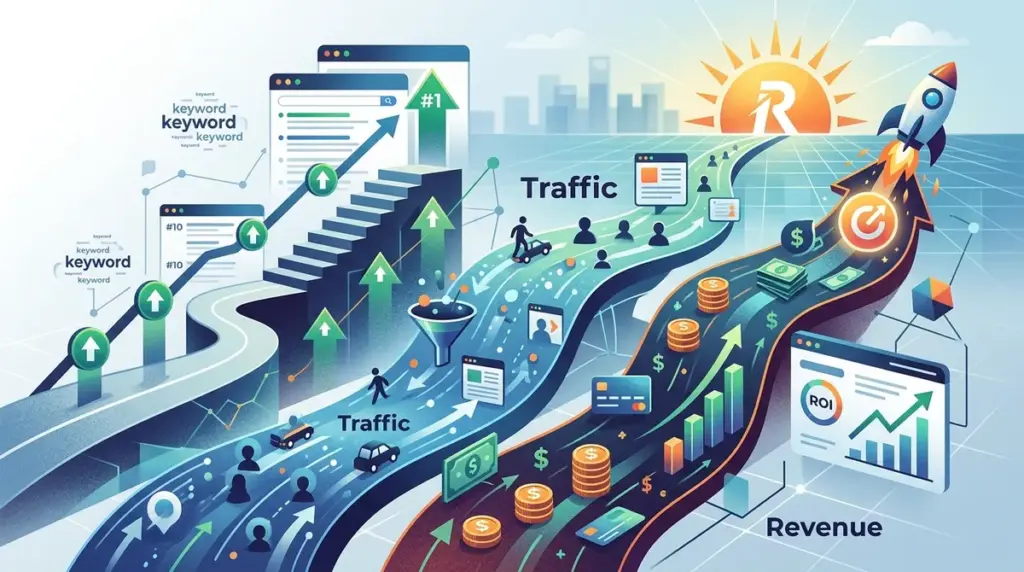
Marketing departments often collapse into two camps: those who obsess over the visibility of a keyword and those who only care about the bottom line of a spreadsheet. The tension between rankings, traffic, and revenue isn't just a matter of preference; it is a fundamental strategic choice that dictates how a budget is allocated and how success is measured. If you optimize for rankings alone, you risk "vanity visibility" that yields zero ROI. If you focus solely on immediate revenue, you likely neglect the top-of-funnel authority required to sustain long-term growth. To build a high-performance search engine strategy, you must treat these three metrics as a sequence rather than a choice.
Rankings as a Leading Diagnostic Tool
Rankings are the most volatile and immediate feedback loop in search marketing. While they are often dismissed as vanity metrics by C-suite executives, for an SEO lead, they function as an early warning system. A sudden drop in position for a primary "money term" is a precursor to a traffic slump, which eventually leads to a revenue deficit.
Best for: Gauging technical health, monitoring competitor movements, and validating the impact of recent on-site optimizations.
However, the value of a ranking is non-linear. The difference between position one and position four is not a slight dip; it is a cliff. Studies consistently show that the top spot captures roughly 27% to 30% of clicks, while position ten captures less than 3%. If your strategy celebrates "Page 1" status without pushing for the top three spots, you are effectively leaving 90% of the potential traffic on the table. Rankings should be used to identify which pages are "striking distance" opportunities—those sitting in positions 4 through 10 that require a final push in content depth or backlink authority to unlock exponential traffic gains.
Warning: Chasing high rankings for high-volume keywords with "informational" intent can inflate your ego while draining your server resources. If a keyword like "what is cloud computing" ranks #1 but your product is a niche enterprise security tool, that ranking is a cost center, not a profit center.
The Traffic Quality Filter
Traffic is the bridge between visibility and value. However, not all sessions are created equal. A site receiving 100,000 monthly visits from a viral blog post may generate less revenue than a site receiving 1,000 visits from a highly targeted "commercial intent" landing page. The goal of a sophisticated search strategy is to maximize "Qualified Traffic"—users whose search queries align with your solution's value proposition.
To evaluate traffic effectively, look beyond the raw numbers in your analytics dashboard. Analyze the following indicators to ensure your traffic has the potential to convert:
- Search Intent Alignment: Does the landing page satisfy the user's specific stage in the buyer’s journey (Awareness, Consideration, or Decision)?
- Bounce Rate by Source: High traffic with a 90% bounce rate suggests a mismatch between the meta title's promise and the page's actual content.
- Pages per Session: For B2B or complex SaaS, high-quality traffic usually involves the user exploring "Features," "Pricing," or "Case Study" pages after the initial entry.
- Assisted Conversions: Organic traffic often introduces a brand to a user who later converts via a direct visit or a branded PPC ad.
When traffic leads the strategy, the focus shifts to user experience (UX) and conversion rate optimization (CRO). It is often more cost-effective to double the conversion rate of existing traffic than it is to double the total volume of traffic through new content production.
Revenue as the North Star Metric
For any commercial entity, revenue is the only metric that justifies the existence of an SEO or PPC budget. However, using revenue as the *only* lead metric can lead to short-sightedness. Because SEO is a lagging indicator—often taking 3 to 6 months to show significant movement—judging a new campaign solely on this month's revenue can result in the premature cancellation of a winning strategy.
Best for: Stakeholder reporting, budget justification, and long-term channel scaling.
To lead with revenue, you must implement robust attribution modeling. You need to know if a user first found you through a "how-to" guide (Rankings/Traffic) before returning two weeks later to buy. If you only credit the final click, you will undervalued your top-of-funnel SEO efforts and over-invest in bottom-of-funnel retargeting, eventually starving your pipeline of new leads.
The Yield-Per-Click Framework
A revenue-first mindset requires calculating the "Yield-Per-Click" (YPC) for different keyword clusters. By multiplying the average conversion rate of a page by the average order value (AOV), you can assign a dollar value to every organic visit. This allows you to prioritize ranking improvements for keywords that offer the highest financial return, rather than those with the highest search volume.
Balancing the Search Performance Funnel
The most successful agencies and in-house teams use a tiered approach where different metrics lead at different stages of a site’s lifecycle. A new site cannot lead with revenue because it lacks the authority to rank for high-intent, competitive terms. In the first six months, rankings must lead to prove the site is gaining "trust" with search engines. Once a baseline of visibility is established, traffic and engagement metrics take the lead to ensure the content resonates with the audience. Only after the "traffic engine" is humming does the focus shift entirely to revenue and conversion efficiency.
If you are managing a mature brand, your focus should be on "Defensive Rankings" (protecting your high-revenue terms) and "Incremental Traffic" (finding new niche clusters). If you are a challenger brand, your focus should be "Aggressive Rankings" (displacing incumbents on high-volume terms) to build the initial awareness necessary for future revenue.
Prioritizing Your Search Strategy
To move from data collection to actionable growth, follow this hierarchy of operations. Start by auditing your current "money pages" to see where they rank. If they are on page two, your primary goal is rankings. If they are in the top three but have low CTR, your goal is traffic optimization (meta data and SERP features). If they have high traffic but low sales, your goal is revenue optimization (CRO and offer alignment).
- Step 1: Identify keywords with high commercial intent that currently rank in positions 4–15.
- Step 2: Optimize those specific pages for better user engagement and internal linking to push them into the top 3.
- Step 3: Audit the conversion funnel of those high-ranking pages to ensure the "ask" matches the user's intent.
- Step 4: Reinvest the revenue generated from these wins into broader, top-of-funnel "authority" content to widen the net.
Frequently Asked Questions
Which metric is most important for a new website?
Rankings are the most important initial metric. Without visibility for relevant keywords, you cannot generate the traffic data needed to optimize for revenue. Early rankings signal that search engines have indexed and categorized your site correctly.
Can high traffic ever be a bad thing?
Yes. If you are driving massive amounts of traffic to pages that have no path to conversion or attract a demographic that cannot buy your product, you are increasing your bounce rate and potentially slowing down your site, which can negatively impact your overall domain authority.
How do I explain the value of rankings to a CEO who only cares about sales?
Frame rankings as "Market Share" or "Share of Voice." Explain that for every spot you don't occupy in the top three, a competitor is capturing the leads that should be yours. Use "Estimated Traffic Value" (what that traffic would cost in PPC) to put a dollar figure on organic rankings.
What is a good conversion rate for organic search traffic?
This varies by industry, but a standard benchmark for B2B is 2-5%, while e-commerce often sees 1-3%. However, "informational" blog posts may have a conversion rate of less than 1%, which is acceptable if they are effectively moving users into an email funnel or retargeting list.