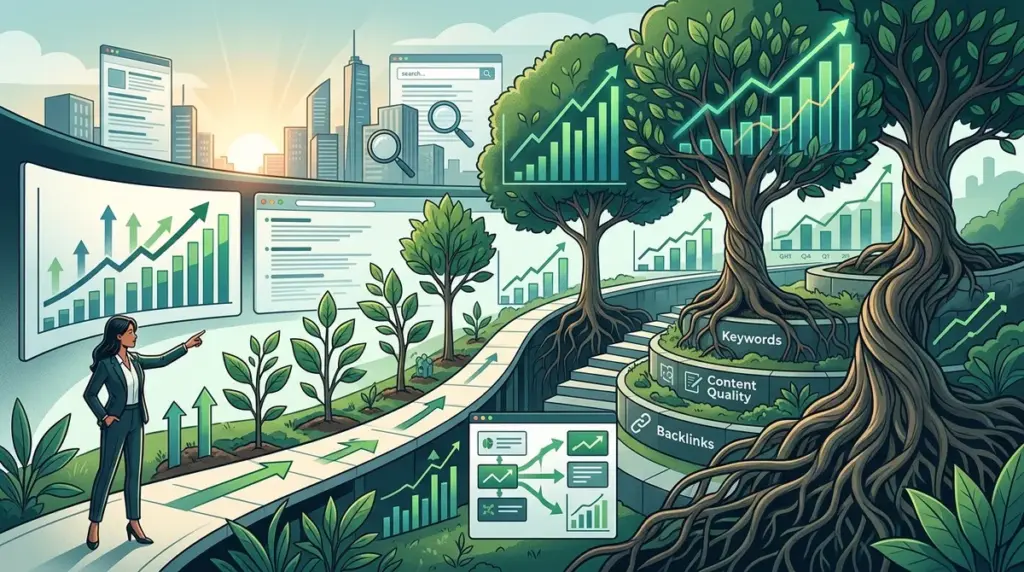
Marketing budgets often bleed out through the high cost of customer acquisition in paid channels. While PPC provides immediate visibility, it is a rental model; the moment the spend stops, the traffic vanishes. Sustainable SEO growth represents the transition from renting an audience to owning an asset. This shift does not happen linearly. It follows a predictable, compounding curve where the initial investment seems disproportionately high compared to the results, only to flip as the cost-per-acquisition (CPA) drops and organic equity takes over the heavy lifting of lead generation.
The First 90 Days: Technical Debt and Indexing Baselines
The initial phase of an SEO campaign is rarely about ranking for "trophy" keywords. It is a diagnostic and remedial period focused on removing the friction between your site and search engine crawlers. Most established sites carry significant technical debt—broken internal links, bloated JavaScript, and poor mobile rendering—that prevents Google from accurately valuing the content.
Focus: Crawl efficiency and indexation health.
During these first three months, growth looks like a "cleaning of the house." You should expect to see an increase in the number of indexed pages and a decrease in crawl errors. While total traffic might remain flat, the quality of that traffic often improves as you prune low-value "zombie" pages that dilute your site’s topical authority. If you are starting a new domain, this period is about establishing an entity relationship in the Knowledge Graph, signaling to search engines exactly what your business does and which niche it serves.
Remediating Core Web Vitals
Google’s Page Experience signals are not just tie-breakers; they are prerequisites. Sites that fail the Core Web Vitals (CWV) thresholds—specifically Largest Contentful Paint (LCP) and Cumulative Layout Shift (CLS)—often face a glass ceiling. In the first 90 days, engineering resources should be directed toward server response times and asset optimization. This creates the performance floor required for the next phase of growth.
The 4-8 Month Window: The Inflection Point
Between months four and eight, the "hockey stick" curve typically begins to form. This is the period where keyword maturation occurs. Content published in month one starts to earn its first meaningful backlinks and moves from page five to the bottom of page one. This is the most dangerous phase for stakeholders because the investment has been significant, but the revenue impact is often still nascent.
Sustainable growth at this stage is characterized by "Impression Lead." You will see a massive spike in Google Search Console impressions before you see a corresponding spike in clicks. This indicates that your content is being tested in high-value SERP positions. The goal here is to optimize Click-Through Rates (CTR) by refining meta titles and descriptions to beat the established competition.
Warning: Do not pivot strategy during the month 5 lull. Many brands abandon their content clusters right before the algorithm fully associates their domain with the target topic. SEO success is as much about persistence in a single vertical as it is about technical execution.
The 9-18 Month Phase: Compounding Organic Equity
After nearly a year of consistent execution, the relationship between effort and reward shifts. You are no longer fighting for every single keyword; your domain authority allows new content to rank almost instantly. This is the compounding phase. A single high-performing "pillar" page can now support dozens of "spoke" articles through internal linking, passing link equity throughout the site architecture.
- Keyword Dominance: You begin to capture "long-tail" variations of your primary head terms without additional content creation.
- Brand Search Growth: As your informational content solves problems for users, they begin searching for your brand name directly, which is a massive trust signal to search engines.
- Reduced CAC: The cost to acquire a lead through organic search often drops to 20-30% of the cost of a paid lead in the same vertical.
Protecting the Moat with Content Refreshes
Growth is not a "set and forget" metric. Once you reach the top three positions for high-intent keywords, you become the target. Competitors will analyze your backlink profile and content structure to outmaneuver you. Sustainable growth requires a "defensive" SEO strategy, which involves updating old content with new data, refreshing outbound links, and ensuring that your information remains more comprehensive than the newer entries in the SERP.
The Delta Between Traffic and Revenue
Raw traffic is a vanity metric if it does not map to the bottom line. Sustainable growth must be measured by the conversion rate of organic visitors. This involves mapping content to the buyer’s journey:
Top of Funnel (ToFu): Educational content that captures users searching for "how-to" or "what is" queries. This builds the remarketing pool.
Middle of Funnel (MoFu): Comparison guides and "best of" lists that capture users evaluating solutions.
Bottom of Funnel (BoFu): Product pages and case studies optimized for high-intent, transactional keywords.
A healthy SEO profile shows growth across all three tiers. If your traffic is growing but your leads are flat, you likely have an imbalance where you are attracting "info-seekers" but failing to capture "solution-seekers."
Building Your 12-Month Performance Roadmap
To achieve this trajectory, your roadmap must be divided into logical workstreams. Start with a 30-day technical audit and fix phase. Follow this with a 60-day content sprint focusing on "low-hanging fruit"—keywords where you already rank on page two. From day 90 to 180, shift focus to aggressive backlink acquisition and the creation of "linkable assets" like original data reports or proprietary calculators. Finally, from day 180 onwards, move into a cycle of content expansion and historical optimization. This structured approach ensures that you aren't just chasing keywords, but building a scalable marketing machine that produces predictable returns over time.
SEO Growth FAQ
How long does it actually take to see ROI from SEO?
While minor technical fixes can show results in weeks, meaningful ROI typically takes 6 to 12 months. This timeline depends on the competitive density of your niche and the existing authority of your domain. High-competition sectors like SaaS or Finance may take longer to break into the top three positions.
Why did my traffic drop after a period of steady growth?
Traffic plateaus or drops are often caused by "content decay" or core algorithm updates. If your content hasn't been updated in 12+ months, competitors with fresher data may displace you. Alternatively, a drop could signal a technical issue, such as a botched site migration or unintended "noindex" tags.
Should I stop PPC once my SEO rankings are high?
Rarely. The most effective strategy is "SERP Dominance," where you occupy both the paid ad slot and the top organic spot. This increases the statistical likelihood of a click and prevents competitors from poaching your high-intent traffic. However, you can often reduce PPC spend on keywords where you have a permanent organic foothold.
What is the most important metric for sustainable growth?
Beyond revenue, the most critical metric is "Non-Brand Organic Traffic." This measures your ability to reach new customers who aren't already looking for your company, proving that your SEO strategy is successfully expanding your market reach.