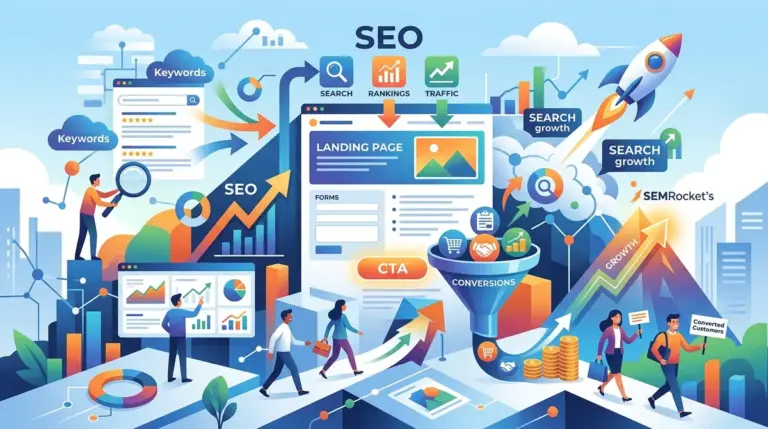
Marketing departments frequently treat Search Engine Optimization (SEO) and Conversion Rate Optimization (CRO) as distinct disciplines with separate budgets and competing KPIs. This siloed approach creates a fundamental friction: SEO teams drive high volumes of traffic that may not be ready to buy, while CRO teams optimize pages for sales at the expense of the technical structures search engines require. When these two functions are misaligned, you pay for traffic that doesn't convert or build high-converting pages that no one ever finds.
The most profitable search strategies treat SEO and CRO as a single continuous funnel. SEO handles the acquisition of intent-driven users, while CRO ensures that the intent is satisfied through specific actions. By integrating these workflows, agencies and site owners can lower their Customer Acquisition Cost (CAC) and improve the lifetime value of organic traffic.
Aligning Keyword Intent with Conversion Pathways
The primary point of failure in most campaigns is a mismatch between the user’s search intent and the page’s call to action (CTA). If a user searches for "how to calculate churn rate," they are in an informational mindset. Forcing a "Book a Demo" popup immediately upon entry is a CRO tactic that ignores the SEO context, leading to high bounce rates and declining search rankings. This highlights the critical need to ensure how search intent aligns with page content to avoid frustrating users and damaging your rankings.
Best for: Reducing bounce rates and improving dwell time metrics that influence Google’s perception of page quality.
- Informational Intent: Use low-friction CTAs like newsletter signups or whitepaper downloads.
- Commercial Intent: Provide comparison tables, case studies, or "Save for Later" features.
- Transactional Intent: Direct the user toward "Add to Cart" or "Get a Quote" with minimal distractions.
By mapping keywords to specific stages of the conversion funnel, you ensure the page provides the exact value the user expected when they clicked the SERP link. This alignment keeps users on the page longer, signaling to search engines that the result is highly relevant, which reinforces the page's authority.
Technical Synergy: Core Web Vitals and UX
Modern SEO is increasingly focused on User Experience (UX) through metrics like Core Web Vitals (CWV). Largest Contentful Paint (LCP) and Cumulative Layout Shift (CLS) are not just ranking factors; they are direct indicators of how likely a user is to convert. A page that shifts while a user is trying to click a button is a CRO nightmare that also happens to be an SEO liability. Focusing on improving user experience for better conversions directly supports your SEO efforts by keeping users engaged and satisfied.
When optimizing for speed, the SEO goal is to pass the CWV threshold. The CRO goal is to remove friction. Combining these efforts means prioritizing the loading of "above-the-fold" conversion elements. If your primary CTA button takes four seconds to become interactive (Total Blocking Time), your SEO might be fine, but your conversion rate will crater. Technical optimization must serve both the bot’s crawl budget and the human’s patience.
Warning: Over-optimizing for SEO by adding 2,000 words of "filler" content to a product page can dilute the conversion focus. If the user has to scroll past five paragraphs of keyword-stuffed history to find the "Buy" button, your CRO will suffer regardless of your ranking position.
Using Heatmaps to Refine Content Architecture
SEO professionals often use H2 and H3 tags strictly for keyword density and semantic relevance. However, CRO data—specifically heatmaps and scroll maps—reveals how users actually interact with those headings. If a heatmap shows that 70% of users stop scrolling at a specific H2, that section is likely a conversion killer or a cognitive dead end.
By analyzing where users drop off, SEOs can restructure content to keep users engaged. If a high-ranking page has a high bounce rate, the CRO data might suggest moving the most valuable information (and the CTA) higher in the document. This change satisfies the user faster, which improves "pogo-sticking" metrics in search results, ultimately protecting the page’s ranking from competitors who provide more immediate value.
The Role of A/B Testing in Organic CTR
A/B testing is a staple of CRO, but it is underutilized in SEO. Meta titles and descriptions are essentially the "ad copy" of organic search. A high ranking is useless if the Click-Through Rate (CTR) is low. By running A/B tests on page titles—testing emotional triggers versus functional descriptions—you can identify which language resonates with your audience.
Once you identify a winning headline through CRO testing on landing pages, apply those insights to your meta tags. If a specific value proposition (e.g., "Free Shipping" vs. "10% Off") converts better on-page, it will likely drive a higher CTR in the SERPs. This creates a virtuous cycle where better CRO data leads to better SEO performance.
Building a Unified Optimization Roadmap
To stop the tug-of-war between SEO and CRO, teams must adopt a unified roadmap. Start by auditing your top 20 highest-traffic pages. Identify the primary keyword for each page and determine if the current CTA matches the intent of that keyword. If a page ranks for "best CRM for small business" but only offers a generic "Contact Us" page, you are leaving revenue on the table.
Next, evaluate the technical performance. Use tools to identify scripts or heavy images that are slowing down the conversion path. Often, third-party tracking scripts used for CRO can slow down a page enough to hurt SEO. Consolidate your tracking pixels and ensure they load asynchronously to protect your LCP scores. Finally, implement a regular review cycle where SEO ranking shifts are analyzed alongside conversion fluctuations to ensure that an increase in traffic is actually translating to an increase in lead volume.
Frequently Asked Questions
Does CRO help with SEO rankings?
Indirectly, yes. While CRO focuses on conversions, the improvements it requires—such as faster load times, better mobile responsiveness, and higher user engagement—are all signals that Google uses to determine page quality and ranking order.
Can SEO content hurt my conversion rate?
Yes, if the content is written solely for search engines. Long-form content designed to capture "top of funnel" keywords can distract users from the primary conversion goal if it isn't structured with clear, accessible CTAs and a logical flow.
How do I balance keyword density with persuasive copy?
Focus on semantic relevance rather than raw density. Use keywords in your headings and introductory paragraphs to satisfy search engines, but use the body copy to address user pain points and benefits to satisfy the reader. If the copy feels forced, it will likely hurt your conversion rate.
Should I A/B test my SEO landing pages?
Absolutely. However, ensure that your A/B testing tool uses canonical tags or redirects correctly to avoid duplicate content issues that could lead to search engine penalties. Always test elements that don't fundamentally change the topic of the page to maintain keyword relevancy.