SaaS SEO is a mathematical exercise in customer acquisition cost (CAC) reduction. Unlike traditional e-commerce or lead-gen sites where a conversion happens once, a SaaS company relies on recurring revenue, making the lifetime value (LTV) of a search visitor significantly higher. This shifts the priority from raw traffic volume to pipeline velocity and retention-focused content. If your SEO strategy is still chasing high-volume, low-intent keywords, you are likely inflating your bounce rate while starving your sales team of qualified leads.
The Shift from Information Retrieval to Jobs-to-be-Done
General SEO focuses on answering questions. SaaS SEO must focus on solving workflows. The "Jobs-to-be-Done" (JTBD) framework should dictate your keyword research. Users don't just want to know "what is project management"; they want to solve the specific problem of "how to track remote team productivity." This means shifting from broad informational content to truly solving specific problems with your product, directly addressing user pain points.
Best for: Reducing churn and capturing high-intent users who are ready to trial a solution rather than just read a definition.
To execute this, map your features to specific pain points. If your software automates invoice processing, your target keywords shouldn't just be "invoicing software." They should include "automated accounts payable workflow" or "how to reduce manual data entry in accounting." These queries represent a user who has identified a friction point in their business and is actively seeking a tool to remove it.
Product-Led SEO and the Utility Moat
The most successful SaaS companies treat their SEO assets as mini-products. Instead of just writing a 2,000-word blog post about "how to calculate churn," build a functional churn calculator. This creates a "utility moat" that is difficult for competitors to replicate with simple text.
- Free Tools: Calculators, generators (e.g., invoice generators), and analyzers provide immediate value and act as a natural entry point into the product ecosystem.
- Template Galleries: If your software is a platform (like a CRM or project manager), creating indexable pages for "marketing plan templates" or "sales pipeline spreadsheets" captures users at the exact moment they need a structure your software provides.
- Programmatic SEO: For SaaS tools that handle data, creating thousands of landing pages based on specific integrations or data points (e.g., "Connect [App A] to [App B]") can capture long-tail search intent at scale.
Warning: Avoid "SEO-first" tools that provide zero utility. If a user lands on a "free generator" page and finds a broken script or a gated form that requires an email before showing results, your bounce rate will spike, and your rankings will eventually crater due to poor user signals.
Capitalizing on High-Intent Comparison Keywords
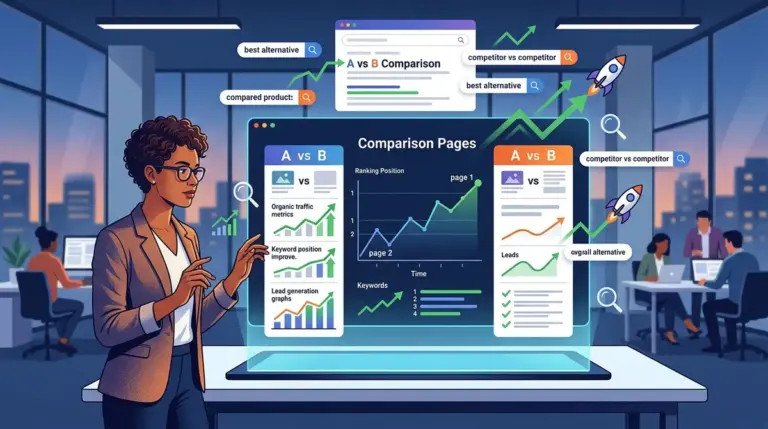
In the SaaS world, buyers are rarely looking for a brand-new category; they are usually looking to switch from a competitor or find a better version of what they currently use. This makes "Alternative" and "Comparison" pages the highest-converting assets in your portfolio.
Do not shy away from naming your competitors. Create dedicated landing pages for "[Competitor] Alternatives" and "[Your Brand] vs [Competitor]." The goal here isn't to bash the competition but to provide a transparent feature-to-feature breakdown. Focus on the specific niches where your product wins—whether that is pricing transparency, a specific integration, or a more intuitive UI for small teams.
These pages often have lower search volume than broad category terms, but the conversion rate is typically 5x to 10x higher because the searcher is at the bottom of the funnel, ready to make a purchasing decision.
Technical Architecture for Dynamic SaaS Platforms
SaaS websites often struggle with technical SEO because the "marketing site" and the "app" frequently sit on different infrastructures. Many SaaS companies use a subdirectory (SEMRocket/blog) or a subdomain (SEMRocket) for their content. From a pure SEO perspective, subdirectories are generally preferred as they consolidate backlink equity and domain authority more effectively than subdomains.
Furthermore, many SaaS products are built on JavaScript frameworks like React or Vue. If your public-facing marketing pages or documentation are rendered client-side without a proper server-side rendering (SSR) or pre-rendering strategy, search engine crawlers may fail to index your content accurately. Ensure your technical stack supports static site generation (SSG) for marketing pages to guarantee lightning-fast load times and perfect indexability.
Building a Link Profile Through Integration Partners
Standard guest posting is often a waste of resources for SaaS. Instead, leverage your integration ecosystem. Every time your software integrates with another platform, there is an opportunity for a co-marketing campaign and a high-authority backlink. Reach out to your partners to be included in their "App Marketplace" or "Integration Directory." These are not just links; they are referral traffic sources that carry high trust and relevance.
Additionally, use your own proprietary data to earn links. SaaS companies sit on mountains of anonymized user data. Publishing an annual "State of the Industry" report based on your internal data is a magnet for journalists and industry bloggers looking for credible statistics to cite. This "data-led PR" creates a natural link profile that is nearly impossible for competitors to buy or fake.
Audit Your Funnel and Reallocate Resources
To move the needle in the next 90 days, stop focusing on your highest-volume keywords and start auditing your conversion data. Identify the top 10 pages that currently drive the most "Trial Signups" or "Demo Requests," regardless of their traffic levels. Double down on those themes. If a page for "enterprise resource planning for mid-sized manufacturers" drives three sales a month with only 50 visitors, that page is infinitely more valuable than a "what is ERP" guide getting 5,000 visitors and zero signups. Optimize your internal linking to funnel authority from your high-traffic blog posts into these high-converting "money pages."
SaaS SEO FAQ
Should we use a subdomain or subdirectory for our blog?
Use a subdirectory (/blog) whenever possible. It allows your content to benefit from the root domain's authority and ensures that any backlinks earned by your content directly support the rankings of your product and landing pages.
How do we handle SEO for a Single Page Application (SPA)?
Use Server-Side Rendering (SSR) or a solution like Next.js or Nuxt.js. This ensures that the HTML is fully rendered when the crawler hits the page, preventing indexing delays or failures common with client-side JavaScript execution.
Are "Alternative" pages bad for our brand image?
No. They are essential for capturing users who are already unhappy with their current solution. As long as the comparison is factual and highlights your specific strengths, it serves as a helpful resource for the buyer and a high-intent lead source for your sales team.
How long does it take for SaaS SEO to show ROI?
While technical fixes can show results in weeks, a content-led strategy typically takes 6 to 12 months to compound. However, because SaaS relies on recurring revenue, the ROI of SEO often surpasses PPC after the first year as the cost per acquisition (CPA) continues to drop while the organic traffic grows.