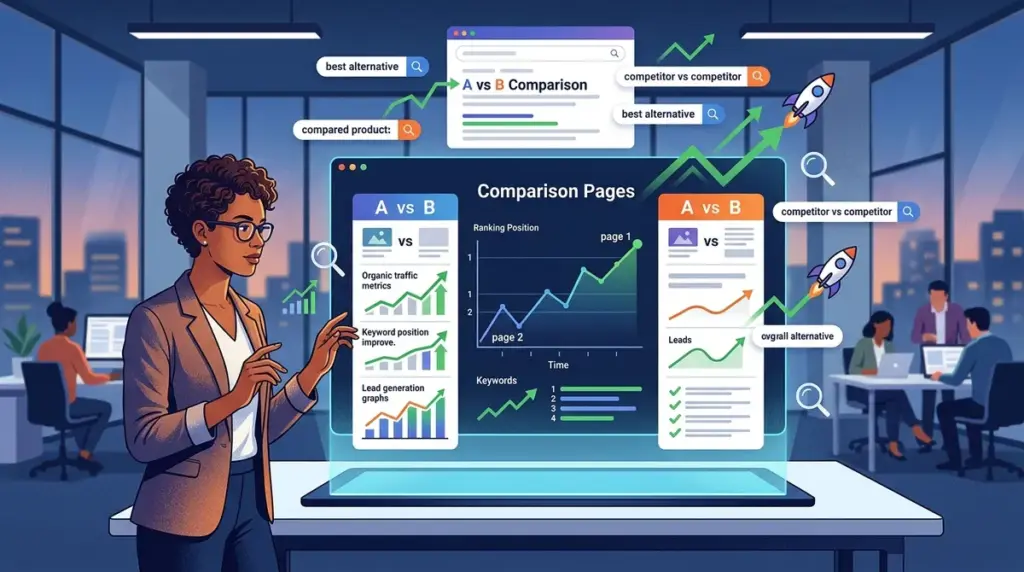
In the SaaS landscape, the most expensive click is the one that goes to a competitor when a prospect is 90% through their buying journey. Comparison pages—often structured as "Your Brand vs. Competitor X"—are the final checkpoint for high-intent buyers. These users have moved past the educational phase of "how to solve a problem" and are now in the selection phase of "which tool solves it best." Failing to own this search real estate means allowing competitors or third-party review sites to define your product's narrative.
Capturing High-Intent Traffic with Comparison Keywords
Comparison keywords represent the narrowest part of the conversion funnel. When a user searches for "Salesforce vs HubSpot" or "Best Jira alternatives," they are signaling readiness to buy. For a SaaS company, these pages serve two primary functions: defensive and offensive. Defensively, you protect your brand from competitors bidding on your name. Offensively, you intercept prospects considering a rival by highlighting your specific differentiators.
Primary Goal: To reduce friction in the decision-making process by providing a side-by-side analysis that favors your product's unique value proposition without appearing overtly biased or deceptive.
Identifying the Right Competitors for Comparison
Not every competitor deserves a dedicated comparison page. Focus on three distinct categories to maximize ROI on content production:
- The Market Leader: These are the "Goliaths" in your space. Even if your product is smaller, comparing yourself to the industry standard anchors your brand in the same category and captures spillover search volume.
- The Direct Feature Rival: The tool you lose to most often in sales demos. These pages should focus on granular feature parity and specific workflow efficiencies.
- The Legacy Solution: Established, older software that lacks modern integrations or speed. The angle here is "Modernization vs. Technical Debt."
Designing the Comparison Matrix for Conversion
A wall of text will fail. SaaS buyers scanning comparison pages want data they can present to stakeholders. The layout must prioritize scannability. Use a comparison table as the centerpiece, but ensure it goes beyond simple checkmarks. Binary "Yes/No" tables are often viewed with skepticism; instead, use descriptive labels like "Native Integration," "Third-party Plugin," or "Limited API Access" to build trust through transparency.
Best for: Products with a clear technical advantage or a significantly more intuitive UI that can be demonstrated through side-by-side screenshots.
Pro Tip: Avoid the "Perfect Column" trap. If your comparison table shows your product has every single feature and the competitor has none, savvy buyers will dismiss it as marketing fluff. Acknowledge one or two areas where the competitor excels—perhaps they serve enterprise legacy systems better—while explaining why your focus on a different area (e.g., speed or ease of use) is the superior trade-off for the target user.
The Importance of Objective Benchmarking
To rank these pages and keep them high-converting, you must use objective metrics. Cite third-party review aggregates, mention specific API limitations found in public documentation, or provide speed test results. When you claim your software is "faster," back it up with a millisecond comparison of page load times or database query execution. This level of detail prevents the page from being flagged as low-quality "thin content" by search engines and provides the "social proof" necessary to move a lead to a trial signup.
Technical SEO for Comparison Pages
Comparison pages require a specific technical approach to ensure they appear for "vs" queries. The URL structure should be clean and predictable, such as /vs/competitor-name. This helps search engines understand the relationship between the entities. Additionally, the meta title should directly reflect the search query: "YourBrand vs Competitor: Features, Pricing, and Performance Compared (2024)."
Internal Linking and Information Architecture
Comparison pages should not live in a silo. They are most effective when linked from top-of-funnel blog posts. If you have a guide on "How to Scale SaaS Infrastructure," link to your comparison page against a legacy provider in the section discussing scalability bottlenecks. This guides the user from the "Problem Aware" stage to the "Solution Aware" stage naturally. Furthermore, ensure these pages are included in your XML sitemap and are accessible within two clicks of the homepage, typically via a "Compare" or "Alternatives" link in the footer. This strategy naturally guides users from awareness to decision, complementing efforts in bottom-funnel SEO for SaaS.
Measuring the ROI of Comparison Content
Success for these pages isn't just about organic traffic volume; it is about assisted conversions and lead quality. Because the search volume for specific "vs" terms might be lower than broad industry terms, look at the conversion rate (CVR) and the Customer Acquisition Cost (CAC). A comparison page that brings in only 100 visitors a month but converts 5 of them into $500/month MRR accounts is significantly more valuable than a top-of-funnel blog post bringing in 10,000 visitors who never sign up.
Key Metrics to Track: 1. Goal completions (Trial starts/Demo requests) specifically from comparison URLs. 2. Time on page (High engagement indicates the user is actually reading the feature breakdown). 3. Bounce rate (If high, your comparison may be too biased or the data is outdated).
Executing Your Comparison Page Rollout
Start by auditing your CRM to see which competitors are most frequently mentioned in "Closed/Lost" notes. Create your first three pages targeting those specific rivals. Ensure the content is updated at least once every six months; SaaS products evolve rapidly, and showing an outdated feature list for a competitor destroys your credibility. Once the pages are live, use them as sales enablement tools. Provide the links to your account executives to send to prospects who are currently weighing their options. This dual-use strategy—SEO and Sales Enablement—ensures the content provides value regardless of immediate organic ranking.
Frequently Asked Questions
Should I compare my product to a competitor that is much larger?
Yes. Comparing your SaaS to a market leader allows you to draft off their high search volume. Position your product as the agile, specialized, or more cost-effective alternative to the "bloated" industry standard.
How do I handle competitors who might complain about the comparison?
Stick to publicly available data, such as pricing pages, documentation, and official feature lists. Use "Last Updated" timestamps to show you are making a good-faith effort to be accurate. Avoid disparaging language; focus on objective differences in workflow and architecture.
Will comparison pages hurt my brand's reputation?
Only if they are poorly executed. Transparent, data-driven comparisons are viewed as helpful resources. Buyers are already doing this research on third-party sites like G2 or Capterra; by hosting the comparison yourself, you regain control over the narrative and the user experience.