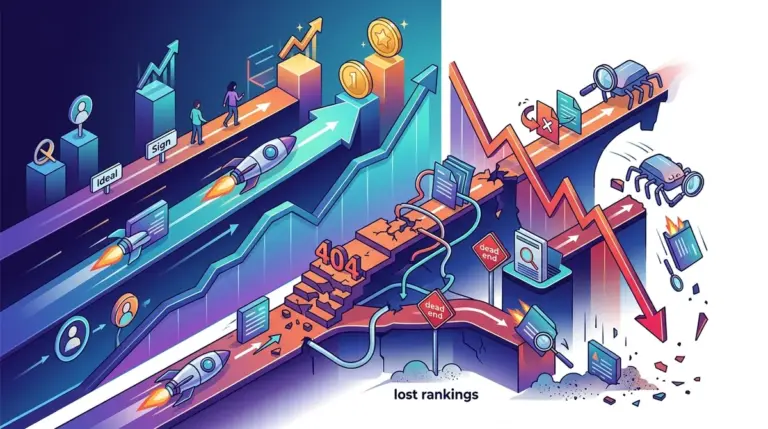
Technical SEO is often treated as a one-time maintenance task, but for scaling domains, it is a compounding liability. When a site grows from 500 pages to 50,000, the margin for error evaporates. Minor misconfigurations in crawl instructions or rendering logic that were once negligible become systemic bottlenecks that suppress rankings for high-intent keywords. If your content is high-quality but your organic growth has plateaued, the issue is rarely the copy; it is the underlying infrastructure preventing Google from efficiently indexing and valuing that copy.
The Hidden Cost of Faceted Navigation and Crawl Bloat
E-commerce and large directory sites frequently fall victim to infinite crawl loops generated by faceted navigation. When filters for size, color, price, and brand create unique URLs for every possible combination, they generate millions of thin, duplicate pages. Googlebot has a finite amount of time to spend on your domain. If it wastes 80% of that budget crawling low-value parameter strings, your new product pages or high-margin category updates may remain unindexed for weeks.
Best for: Large-scale e-commerce and multi-attribute marketplaces.
To solve this, do not rely solely on canonical tags. A canonical tag tells Google which page is the "master" version, but it does not stop the bot from crawling the duplicates. For true efficiency, use the robots.txt file to disallow specific query parameters or implement a "Noindex, Follow" tag on filtered results that do not serve a specific search intent. This forces the crawler to focus on the static, revenue-generating architecture rather than the dynamic noise.
JavaScript Rendering and the Two-Wave Indexing Gap
Modern web frameworks like React, Vue, and Angular offer sleek user experiences but create a "rendering gap" for search engines. Google processes HTML in two waves. The first wave indexes the raw HTML source code. The second wave, which can occur days or weeks later, renders the JavaScript to see the full content. If your primary navigation, internal links, or body text are injected via client-side JavaScript, Google may initially see a blank page.
Pro Tip: Use the "Inspect" tool in Google Search Console to compare the "Crawl" version versus the "Live Test" version. If the "Crawl" version is missing your primary keywords or links, you are suffering from a rendering delay that is actively stalling your rankings.
The solution is Server-Side Rendering (SSR) or Dynamic Rendering. By delivering a pre-rendered HTML snapshot to the bot while serving the interactive JS version to the user, you ensure that content is indexed in the first wave. This is critical for news publishers or fast-moving retail sites where being indexed 48 hours late means missing the entire trend cycle.
Click Depth and the Decay of Page Authority
Site architecture is not just about user experience; it is about the distribution of PageRank. A common growth killer is a "flat" architecture that has become too deep over time. If a high-value landing page is more than four clicks away from the homepage, it receives a fraction of the domain's total authority. Search engines view deep-nested pages as less important, regardless of the content quality.
- Audit your internal link distribution: Use a crawler to map your site's "Crawl Depth."
- Flatten the hierarchy: Use "Related Products" or "Featured Articles" modules to link directly from high-authority tier-1 pages to deeper tier-3 pages.
- Eliminate Orphan Pages: Ensure every live URL is reachable via at least one crawlable text link. Orphan pages—those with no internal links—are virtually invisible to search engines even if they exist in the sitemap.
Core Web Vitals Beyond the Green Score
While many marketers obsess over getting "green" scores in PageSpeed Insights, they miss the commercial impact of Cumulative Layout Shift (CLS) and Largest Contentful Paint (LCP). Technical SEO is now inextricably linked to conversion rate optimization (CRO). A high CLS—where buttons move as the page loads—doesn't just hurt your ranking; it increases bounce rates and destroys mobile ad performance.
Focus on the "Critical Request Chain." Minimize the number of external scripts (trackers, heatmaps, chatbots) that fire before the LCP element. Every millisecond of delay in the LCP is a direct hit to the user's perceived site speed. If your LCP is a hero image, ensure it is preloaded in the HTML head and not lazily loaded. Lazy loading is excellent for images below the fold, but applying it to your main header image is a technical error that artificially inflates your LCP time.
Hreflang Mismanagement in International Scaling
For brands operating in multiple regions, hreflang tags are the most complex yet vital component of technical SEO. A common "quiet killer" is the missing return tag. If Page A (US) links to Page B (UK), but Page B does not link back to Page A via hreflang, Google may ignore the instruction entirely. This results in the wrong version of the site appearing in the wrong regional search results, leading to high bounce rates and lost local currency transactions.
Avoid using "automated" hreflang plugins that do not validate the return links. Instead, implement a centralized XML sitemap for hreflang or hard-code the tags into the header. This ensures that every regional variant is explicitly mapped, preventing "keyword cannibalization" between your own international subfolders.
Building a Technical Debt Remediation Roadmap
The most effective way to prevent technical issues from killing growth is to move from reactive fixing to proactive auditing. Start by segmenting your site into "Page Types" (e.g., Blog, Product, Category). Audit a sample of each type for rendering issues, schema markup validity, and mobile responsiveness. Once the templates are clean, focus on the database level—cleaning up redirect chains (301s leading to 301s) and resolving 404 errors that are still receiving internal link equity. Technical SEO is a game of incremental gains; by removing the friction between your content and the crawler, you allow your marketing efforts to finally reach their full potential. This proactive approach includes thoroughly resolving redirect chains and 404 errors that are still receiving internal link equity.
Technical SEO FAQ
How often should I perform a full technical audit?
For sites with frequent code deployments or content additions, a deep-dive audit should occur quarterly. However, automated monitoring for 404 spikes and server errors should be reviewed weekly to catch deployment regressions early.
Does a 301 redirect lose "link juice"?
While Google has stated that 301 redirects pass full PageRank, "redirect chains" (A to B to C) cause crawl latency and can lead to a loss of equity. Always update internal links to point directly to the final destination URL.
Can I fix technical SEO issues without a developer?
Some issues, like basic meta tags or content-level changes, can be handled via a CMS. However, structural issues like SSR implementation, faceted navigation logic, and server-side redirects require developer intervention to ensure they are handled at the root level rather than through "band-aid" plugins.