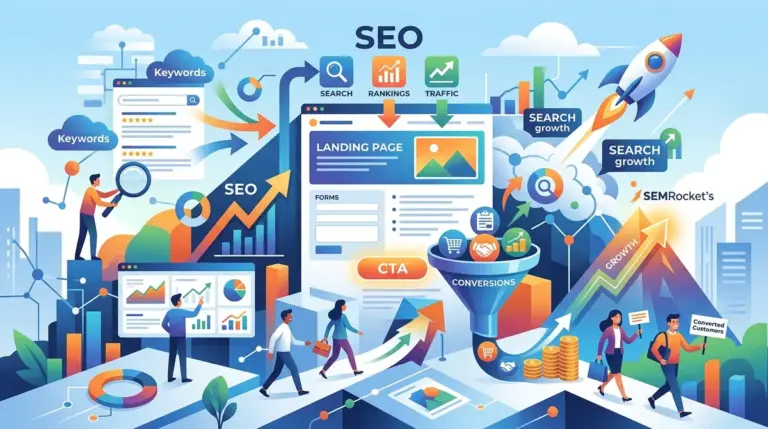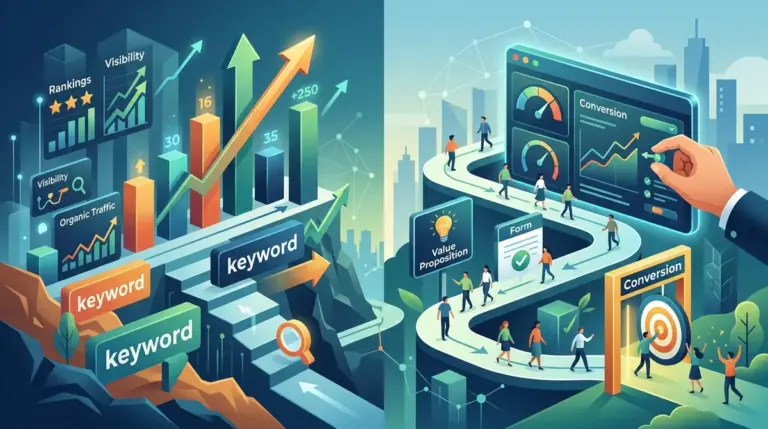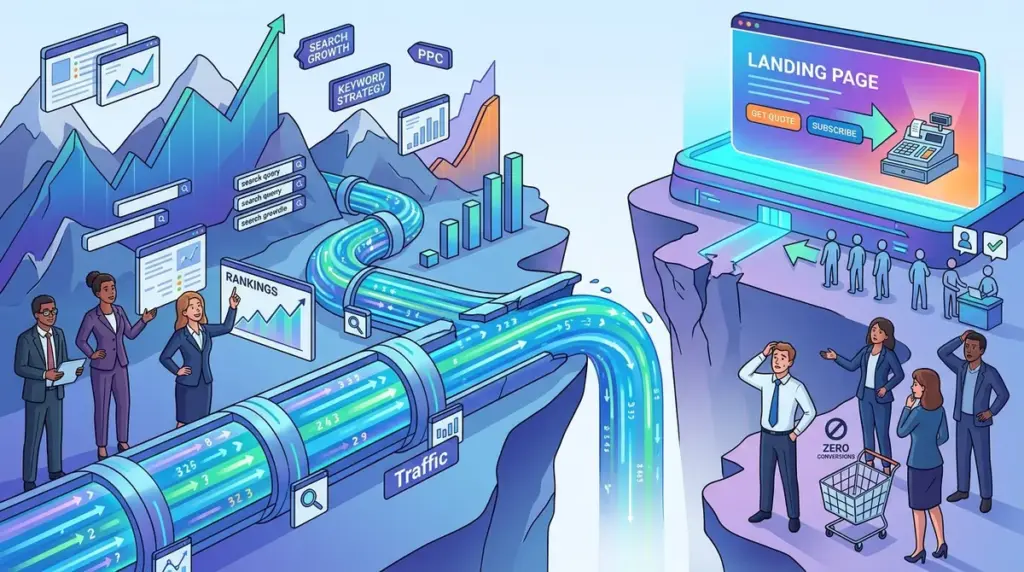
Marketing departments frequently celebrate "hockey stick" growth in organic sessions, yet the finance department often sees a different reality. When traffic climbs while revenue plateaus, the SEO strategy has decoupled from the business objective. High-volume keywords often act as a vanity metric that masks poor targeting, mismatched search intent, and friction-heavy user experiences. In a performance-driven environment, a click that does not lead to a lead, a sale, or a measurable micro-conversion is an overhead cost, not an asset. This disconnect highlights the need to focus on strategies that turn traffic into qualified leads aligned with business goals.
The High Cost of Empty Clicks
Acquiring traffic is not free. Even if you aren't paying for every click via PPC, you are paying for the content production, technical optimization, and link-building required to earn that position. When an SEO campaign focuses solely on volume, it often targets "top-of-funnel" (TOFU) keywords that are too broad to convert. For example, ranking for a term like "marketing" might bring in 100,000 visitors, but if you sell high-ticket enterprise CRM software, 99% of those visitors are looking for definitions, not solutions.
Best for: Marketing managers who need to justify SEO spend to stakeholders by shifting the focus from session counts to pipeline contribution.
Low-intent traffic also skews your data. High bounce rates from irrelevant visitors can signal to search engines that your page isn't satisfying the query, potentially dragging down your rankings for more valuable terms. More importantly, it dilutes your remarketing pools. If your pixel is firing for thousands of users who have zero intention of buying, your retargeting spend in paid channels will be wasted on an unqualified audience.
Aligning Search Intent with the Conversion Path
Conversion issues often start at the keyword research phase. To fix the traffic-conversion gap, you must categorize your target keywords by intent rather than just volume or difficulty. A site that ranks for "how to fix a leaky faucet" is providing a service, but if that site sells professional plumbing services, the visitor likely wants to do it themselves. The conversion rate will naturally be lower than a page targeting "emergency plumber near me."
Transactional vs. Informational Keywords
Informational keywords are vital for brand awareness, but they require a different conversion strategy. You cannot expect a user looking for a "guide to SEO" to immediately book a consultation. Instead, the conversion goal should be a newsletter sign-up or a lead magnet. Transactional keywords, such as "buy organic coffee beans" or "SEO agency pricing," require a direct path to a checkout or a contact form. If you treat all traffic the same, you miss the opportunity to nurture users through their specific stage of the journey.
- Informational Intent: Focus on soft conversions (email captures, whitepaper downloads).
- Navigational Intent: Ensure the brand name and product categories are easily accessible.
- Commercial Investigation: Provide comparison charts, reviews, and case studies.
- Transactional Intent: Minimize clicks to purchase and remove all form fields that aren't strictly necessary.
Warning: Ranking for "best [product]" keywords without having a fast-loading, mobile-optimized comparison table is a recipe for high bounce rates. Users in the commercial investigation phase have low patience for blocks of text; they want data they can scan and act upon immediately.
Technical Friction and the "SEO-UX" Gap
You can lead a user to a page through perfect keyword targeting, but you cannot make them convert if the technical infrastructure is failing. Core Web Vitals are often discussed as ranking factors, but their primary value lies in conversion. A one-second delay in mobile load times can impact conversion rates by up to 20%. If your SEO strategy brings in 50,000 mobile users but your site is sluggish, you are actively losing revenue every hour.
Beyond speed, the layout must respect the user’s "intent-to-action" ratio. If a user lands on a product page via a long-tail search, they shouldn't have to scroll past three paragraphs of "SEO text" to find the "Add to Cart" button. This is a common mistake where agencies over-optimize for bots at the expense of humans. Modern search algorithms are sophisticated enough to understand context without the need for keyword stuffing at the top of the page.
Content That Closes the Deal
SEO content often fails because it is written to satisfy an algorithm rather than to answer a prospect's objections. To turn traffic into revenue, the copy must address the "Why us?" and "Why now?" questions. This involves integrating social proof, clear value propositions, and risk-reversal elements (like guarantees or free trials) directly into the SEO landing pages.
The Role of Micro-Conversions
Not every visitor is ready to buy on their first visit. If your only conversion goal is a "Buy Now" button, you are ignoring 95% of your traffic. Effective SEO strategies incorporate micro-conversions to keep the brand top-of-mind. This includes:
• Adding an item to a wishlist.
• Using an interactive calculator or tool.
• Clicking through to a related case study.
• Spending more than two minutes on a high-value blog post.
Tracking these actions allows you to see if your SEO traffic is "warming up" or simply bouncing. If users are engaging with micro-conversions, the traffic is high-quality; the final "macro-conversion" might just need a better offer or a more persuasive CTA.
Building a Conversion-First SEO Roadmap
To stop wasting budget on vanity traffic, shift your reporting and execution toward a revenue-centric model. Start by auditing your top 20 highest-traffic pages in a search console and cross-referencing them with your conversion data in an analytics suite. If a page has high impressions and clicks but zero goal completions, it is a candidate for a "search intent alignment" overhaul.
Next, implement heatmapping and session recording on your primary organic landing pages. Watch how users interact with the content. Are they clicking on non-clickable elements? Are they scrolling past your primary CTA? This qualitative data is the bridge between SEO and CRO (Conversion Rate Optimization). Finally, stop prioritizing keywords based on volume alone. A keyword with 500 monthly searches and a 10% conversion rate is infinitely more valuable than a keyword with 50,000 searches and a 0.01% conversion rate.
Action Plan:
1. Identify "high-traffic, low-conversion" pages.
2. Re-evaluate the search intent: Does the page content match what the user actually wants?
3. Simplify the CTA: Ensure there is one clear, logical next step for the user.
4. Test page speed: Use tools to identify specific scripts or images slowing down the conversion path.
5. Update the copy: Shift from "what this is" to "how this solves your problem."
Frequently Asked Questions
Does a high bounce rate always mean my SEO is failing?
No. A high bounce rate on a "contact us" page or a specific "check weather" tool might mean the user found exactly what they needed quickly. However, on an e-commerce or lead-gen page, a high bounce rate usually indicates a mismatch between the search query and the landing page experience.
How do I measure SEO ROI if my sales cycle is six months long?
Focus on assisted conversions and lead scoring. Track how many organic visitors download a technical whitepaper or sign up for a webinar. Assign a dollar value to these leads based on historical closing rates to estimate the long-term ROI of your SEO efforts.
Should I delete pages that get traffic but don't convert?
Rarely. If a page gets significant traffic but no conversions, it still provides brand authority and "link juice" to the rest of your site. Instead of deleting it, try to add a "soft" conversion point, like a relevant newsletter sign-up, or add internal links to your high-converting product pages.
Is CRO more important than SEO?
Neither is more important; they are two sides of the same coin. SEO brings the right people to the door, and CRO makes sure they walk in and buy something. Without SEO, you have no one to convert. Without CRO, you are paying for a crowd that never buys.