The Financial Reality of SaaS SEO Strategy
Most SaaS marketing teams prioritize top-of-funnel (ToFu) volume because high traffic numbers look impressive in monthly reports. However, for a B2B SaaS company with a high Customer Acquisition Cost (CAC), 10,000 visitors reading a "What is [Industry]" blog post is often less valuable than 100 visitors searching for "[Competitor] vs [Your Product]." Bottom-funnel (BoFu) SEO targets users who have already identified their problem and are actively evaluating specific solutions. This is where the highest conversion rates live, directly impacting Monthly Recurring Revenue (MRR).
Building a BoFu engine requires moving away from educational content and toward aggressive, product-led search assets. You are no longer answering "why"; you are proving "how" and "how much better." Success in this tier of the funnel depends on capturing high-intent modifiers and presenting a clear, frictionless path to a trial or demo.
Identifying High-Value Bottom-Funnel Modifiers
Keyword research for BoFu SEO differs from traditional keyword research. You aren't looking for broad interest; you are looking for purchase signals. These signals are usually embedded in specific modifiers that indicate a user is in the "Decision" or "Action" stage of the buyer journey.
Primary BoFu Modifiers for SaaS:
- Comparison: [Competitor A] vs [Competitor B], [Your Product] vs [Market Leader].
- Alternatives: [Competitor] alternatives, open source [Category] software.
- Pricing: [Competitor] pricing, [Category] software cost, cheapest [Category] tool.
- Use Case: [Category] for [Specific Industry], [Category] with [Specific Integration].
- Reviews: [Product Name] reviews, best [Category] for enterprise.
To execute this, crawl your competitors' sitemaps to see which "Alternative" or "Vs" pages they are ranking for. If a competitor has a page titled "Best [Category] Software" and you aren't on that list—or don't have your own version—you are ceding high-intent traffic to their sales team.
Constructing Scalable Comparison Frameworks
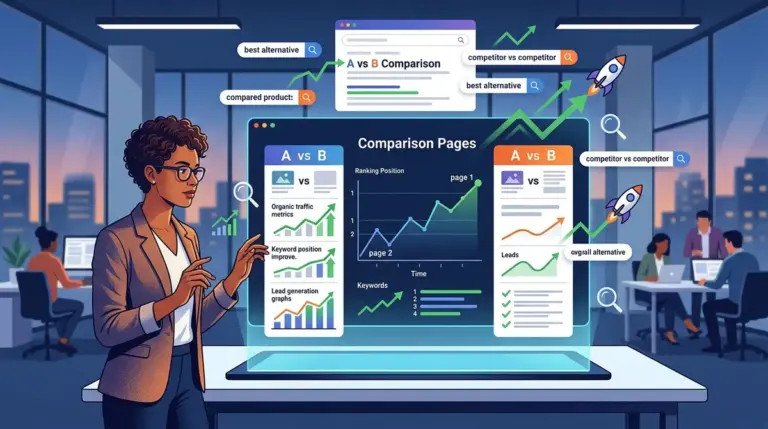
The "Vs" page is the cornerstone of SaaS BoFu SEO. To rank these pages, you must provide more than a biased sales pitch. Google’s helpful content guidelines favor objective, data-backed comparisons. Your goal is to create a resource that helps the user make a decision, even if that decision isn't always your product.
The 1:1 Comparison Page
Direct comparisons should focus on three pillars: feature parity, pricing transparency, and specific use-case superiority. Avoid generic statements like "we are easier to use." Instead, use concrete metrics: "Our onboarding takes 15 minutes compared to the industry average of 4 hours." Use a comparison table at the top of the page to summarize technical specifications, API availability, and support tiers. This table often wins the featured snippet for "vs" queries because it provides structured data that search engines can easily parse.
The "Alternative To" Aggregator
When a user searches for "[Market Leader] alternatives," they are frustrated with a specific aspect of that tool—usually pricing, complexity, or a missing feature. Your landing page must address these pain points immediately. Segment your "Alternative" page by user type (e.g., "Best Alternative for Small Teams" or "Best Alternative for Security-Conscious Developers"). This increases the relevance of your page for long-tail queries and improves the quality of the leads entering your CRM.
Warning: Avoid using "scare tactics" or outdated information on competitor pages. If you misrepresent a competitor’s pricing or features, you risk legal takedown notices and loss of brand credibility. Always include a "Last Updated" timestamp and a link to the competitor’s official pricing page to maintain editorial integrity.
Engineering Feature-Led Landing Pages
Feature-specific SEO targets users looking for a granular solution to a specific problem. If your SaaS is a Project Management tool, "Project Management Software" is ToFu/MoFu. "Gantt Chart Software with Slack Integration" is BoFu. These pages should be built as high-performance landing pages rather than standard blog posts.
Each feature page should include a "How it Works" section with actual product screenshots or short looping videos. This reduces the bounce rate by showing the user exactly what they will get. From a technical SEO perspective, these pages must use Product Schema and FAQ Schema. FAQ Schema allows you to dominate more SERP real estate and answer common objections—like "Does this integrate with Salesforce?"—before the user even clicks your link.
Internal Linking for Conversion Acceleration
BoFu pages often struggle to gain organic backlinks because they are commercially focused. To rank them, you must leverage the "link juice" from your high-traffic ToFu blog posts. This is not just about adding a sidebar link; it is about contextual, high-intent internal linking.
If you have a blog post about "How to Improve Team Productivity," you should link to your "Productivity Software Comparison" page using exact-match or partial-match anchor text. This signals to Google that the comparison page is the authoritative destination for users ready to move beyond education. Furthermore, ensure your BoFu pages are linked directly from your main navigation or footer. If a page is important for revenue, it should never be more than two clicks away from the homepage.
The Direct Path to Trial Signups
The final step in BoFu SEO is optimizing for the click-through to the product. Every BoFu page must have a primary Call to Action (CTA) that is persistent. For SaaS, this is typically a "Start Free Trial" or "Book a Demo" button. However, the CTA must match the intent. If a user is on a "Pricing" page, they are ready for a trial. If they are on a "Vs" page, they might need a "Feature Deep Dive" or a "Migration Guide" first.
Monitor your conversion rates per keyword. If a specific "Alternative" page is ranking #1 but has a 0% conversion rate, the content isn't addressing the specific reason users are leaving that competitor. Re-evaluate the page's value proposition and ensure the "Aha! moment" of your software is front and center.
Executing Your BoFu Roadmap
To begin capturing high-intent traffic, audit your current keyword footprint and identify gaps in your comparison and alternative coverage. Start by building out pages for your top three competitors. Ensure these pages use structured data and clear, feature-based headings. Once these are live, map your highest-traffic blog posts to these new conversion assets via contextual internal links. Track your progress not just by rank, but by the volume of qualified leads and the velocity at which these leads move through your sales pipeline.
Frequently Asked Questions
How do I handle competitors who bid on my brand name in PPC?
Create a dedicated "Our Brand vs [Competitor]" page. This allows you to win the organic spot directly below their paid ad, providing a counter-narrative and potentially lowering their Quality Score for that keyword by providing a more relevant organic destination for the comparison.
Should I include my own pricing on comparison pages?
Yes. Transparency is a major conversion driver in SaaS. If your pricing is complex, provide a "Starting At" figure or a clear comparison of what features are included in your entry-level tier versus the competitor's equivalent. Hiding pricing often leads to higher bounce rates on BoFu pages.
How many "Alternative" pages should I create?
Focus on the "Big Three"—the market leaders your sales team hears about most often during discovery calls. Once those are ranking, expand to niche competitors where you have a specific feature advantage. Quality and depth of comparison matter more than the sheer number of pages.
Is it better to target "Best [Category]" or "[Competitor] Alternatives"?
"Best [Category]" usually has higher volume but higher competition. "[Competitor] Alternatives" usually has higher intent and a clearer pain point to solve. Start with "Alternatives" to capture immediate "switchers," then move to "Best" lists as your domain authority grows.