Most SaaS content strategies fail because they prioritize search volume over commercial intent. When marketing teams report on "upward-trending traffic" while sales teams complain about lead quality, the disconnect usually lies in the keyword selection process. To turn a blog or a resource center into a pipeline engine, you must stop treating content as an awareness tool and start treating it as a sales enablement asset. This requires a fundamental shift from broad, educational topics to high-intent, problem-solving narratives that align with the buyer's journey at the point of decision-making. Shifting focus to high-intent keywords is a core component of building bottom-funnel SEO for SaaS that actually drives revenue.
Prioritizing High-Intent Search Clusters
The fastest way to generate pipeline is to capture existing demand rather than trying to create it from scratch. This means focusing on keywords that indicate a user is actively looking for a solution. In the SaaS world, these typically fall into three buckets: comparison, "alternative to," and category-defining keywords.
Best for: Reducing CAC and shortening the sales cycle by targeting users already in the evaluation phase.
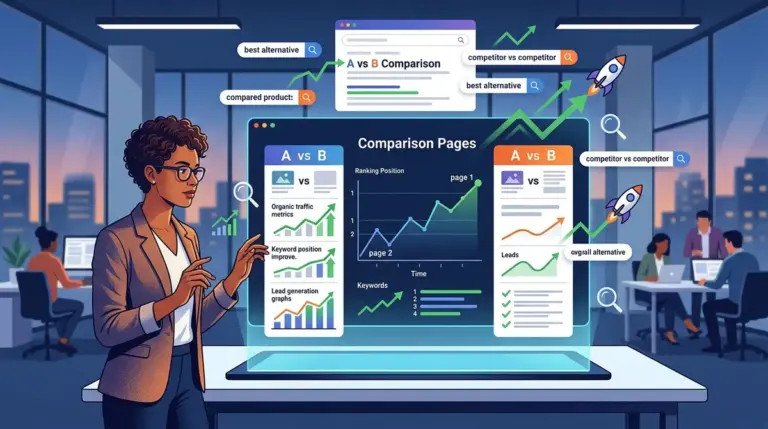
- Comparison Pages: These target users weighing two specific options (e.g., [Competitor A] vs [Competitor B]). By providing an objective, data-backed comparison that highlights your unique value proposition, you insert your brand into a high-stakes conversation.
- Alternative Keywords: Users searching for "alternatives to [Market Leader]" are often frustrated with pricing, complexity, or missing features. These are high-value prospects ready to churn from a competitor.
- Best-of Lists: While competitive, "Best [Category] Software for [Specific Use Case]" keywords allow you to frame the criteria for success in your niche.
Instead of writing a 3,000-word guide on "What is CRM?", which attracts students and entry-level researchers, a revenue-focused team builds a landing page for "CRM for Series A Fintech Startups." The latter has 5% of the volume but 50x the conversion potential.
The Product-Led Content Framework
Product-led content is not a sales pitch disguised as an article; it is an educational piece where your product is the natural solution to the problem being discussed. If a reader finishes your article and doesn't understand how your software solves their specific pain point, the content has failed its primary commercial objective.
To execute this, your writers need deep product knowledge. They should be able to take a screenshot of a specific feature and explain exactly how it automates a manual task or provides a data insight that was previously inaccessible. This moves the reader from "I have a problem" to "I see exactly how this tool fixes it" in a single session.
Warning: Avoid "Brand-Agnostic Content." If you could swap your brand name for a competitor's and the article still makes sense, your content is too generic. Revenue-driving content must be inextricably linked to your product's unique workflow or data set.
Showcasing Utility Over Features
Focus on the "Jobs-to-be-Done" (JTBD). If you sell project management software, don't just write about "better collaboration." Write about "How to sync cross-functional engineering sprints without manual status updates." Use the product interface to illustrate the solution. This builds trust by demonstrating competence before the user even signs up for a trial.
Moving Beyond the "Book a Demo" CTA
The "Book a Demo" button is often too high-friction for someone who just discovered your brand through a search engine. To maximize pipeline, you need a tiered conversion strategy that matches the user's level of intent. A hard CTA is necessary, but secondary CTAs keep prospects in your ecosystem.
Best for: Capturing "not-yet-ready" leads and building a nurture database for long-term pipeline health.
Consider implementing interactive tools such as ROI calculators, templates, or audit checklists. For example, a cybersecurity SaaS might offer a "Free Security Perimeter Audit" rather than just a demo. This provides immediate value and gives your sales team specific data points to use during their initial outreach, making the first sales touchpoint far more relevant and less intrusive.
Distribution Tactics for Immediate Pipeline Impact
SEO is a long-term play, but pipeline needs to move every month. Content distribution should not be an afterthought. Once a high-intent piece of content is live, it should be repurposed across channels where your buyers congregate. This includes LinkedIn, niche Slack communities, and targeted newsletters.
Paid social plays a massive role here. Instead of running ads to a generic homepage, run "Search-to-Social" retargeting. If a user visits a high-intent comparison page via organic search but doesn't convert, retarget them on LinkedIn with a customer case study that validates the claims made on that page. This creates a cohesive narrative that follows the buyer across the web, reinforcing your position as the logical choice.
Leveraging Internal Experts
Content written by "Staff Writer" rarely carries the authority needed to influence a B2B buying committee. Pipeline-heavy SaaS companies leverage their internal subject matter experts (SMEs). Use interviews with your engineers, product managers, or C-suite to add "information gain"—original insights that aren't found in the top 10 results of Google. This original perspective is what earns backlinks and social shares, which in turn boosts your organic rankings for competitive commercial terms.
Operationalizing Your Pipeline Strategy
To scale this approach, you must move away from measuring "traffic" as a primary KPI. Instead, track "Content-Influenced Pipeline" and "MQL to SQL conversion rates by entry page." When you can prove that a specific cluster of comparison articles generated $200k in pipeline last quarter, securing a budget for more aggressive content production becomes a data-driven decision rather than a creative gamble.
Focus on the "Cost Per Acquisition" (CPA) of your content. If an article costs $1,000 to produce and promote but generates three qualified leads with a lifetime value (LTV) of $10,000 each, the ROI is undeniable. This level of granularity is what separates high-growth SaaS marketing teams from those simply "doing content."
Review your existing top-performing pages. Are they driving traffic or revenue? If a high-traffic page has a 0% conversion rate, it needs a CTA overhaul or a structural rewrite to align with product utility. If a low-traffic page has a 10% conversion rate, it needs more distribution and aggressive internal linking. Optimize for the dollar, not the click.
SaaS Content Pipeline FAQ
How long does it take for content to start generating pipeline?
While organic SEO can take 3 to 6 months to mature, you can generate immediate pipeline by distributing high-intent content through paid social and email newsletters. The "intent" of the content is more important than the age of the URL.
Should we gate our high-intent content?
Rarely. Gating high-intent content like comparison guides creates friction for the very people you want reading it. Keep your best insights ungated to build authority and use low-friction CTAs (like templates or calculators) to capture lead data instead.
How do we choose which keywords to target first?
Start at the bottom of the funnel. Map out your top three competitors and create "Alternative to" and "vs" pages. These keywords have the highest conversion rates and provide the fastest feedback loop for your content's effectiveness.
What is the ideal ratio of educational vs. commercial content?
For a SaaS company focused on growth, a 30/70 split is often effective—30% top-of-funnel educational content to build brand awareness and 70% middle-to-bottom-of-funnel content designed specifically to drive conversions and support the sales process.