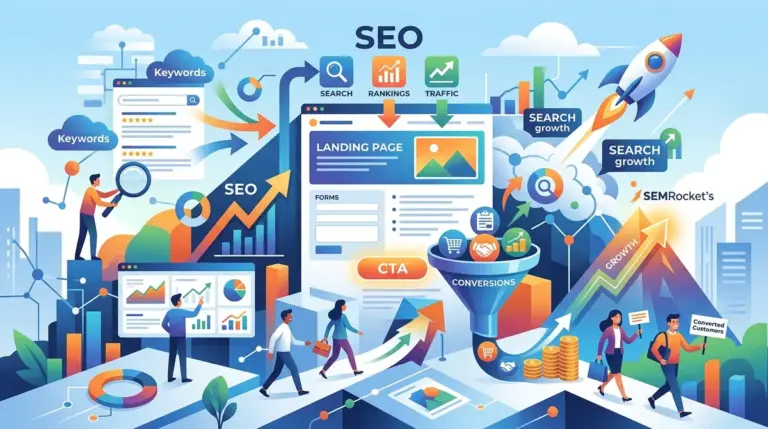
High-volume organic traffic is a vanity metric if it fails to move the needle on revenue. Many SEO strategies focus exclusively on the top of the funnel, capturing broad informational queries that bring users to a site but leave them there with no clear path to conversion. To bridge the gap between a page view and a qualified lead, you must shift from a "traffic-first" mindset to an "intent-first" framework. This requires aligning specific search queries with high-friction or low-friction conversion points based on where the user sits in the buying cycle. This shift in perspective highlights why traffic means little without conversions driving business value.
Aligning Keyword Intent with Conversion Depth
Not all organic traffic is created equal. A user searching for "what is enterprise SEO" is in a research phase, while someone searching for "enterprise SEO agency pricing" is ready to buy. Forcing the latter into a long-form whitepaper is as big a mistake as forcing the former into a "Book a Demo" call. To turn traffic into leads, you must map your keyword list to specific conversion actions. Focusing on user intent throughout the funnel is key to making your landing pages convert effectively.
Informational Intent: Focus on micro-conversions. These users want answers, not sales pitches. Offer newsletter signups, checklists, or templates that solve the immediate problem they searched for.
Commercial Intent: Focus on mid-funnel leads. These users are comparing options. Offer webinars, case studies, or comparison sheets.
Transactional Intent: Focus on direct lead generation. These users are ready to talk. Use high-friction forms, demo requests, or "get a quote" buttons.
Best for: Reducing bounce rates on high-traffic informational posts while building a retargeting pool for future paid social or email campaigns.
The Landing Page Pivot: Optimizing for Searcher Task Accomplishment
Google’s algorithm increasingly prioritizes "Searcher Task Accomplishment." If a user clicks your link, reads your content, but then has to navigate through three more pages to find a solution, you have failed both the user and the search engine. Every high-traffic organic page must function as a landing page.
- Sticky CTAs: Use a non-intrusive floating sidebar or a "sticky" header CTA that remains visible as the user scrolls through long-form editorial content.
- In-Line Lead Magnets: Place a contextual opt-in box exactly where the "how-to" section ends. If the article explains how to audit a site, the lead magnet should be a "10-Point SEO Audit Checklist."
- Social Proof Integration: Don't relegate testimonials to the "About Us" page. Place a relevant client quote or a "Featured In" logo bar directly below the first H2 of your most popular blog posts.
Pro Tip: Audit your top 10 organic traffic drivers in Search Console. If a page has a high click-through rate but a low time-on-site or zero goal completions, the content likely lacks a "logical next step." Add a clear, specific call-to-action that mirrors the phrasing of the primary keyword for that page.
Lead Scoring for Organic Traffic
Not every lead generated from organic search is ready for the sales team. Marketing Qualified Leads (MQLs) from search often require different handling than outbound leads. By implementing lead scoring based on the entry page, you can prioritize follow-ups.
For example, a lead that enters through a "pricing" page and downloads a "feature comparison guide" should be flagged as a high-priority Sales Qualified Lead (SQL). Conversely, a lead that enters through a "top marketing trends" blog post and signs up for a newsletter should be placed in a long-term automated nurture sequence. This prevents your sales team from wasting time on "tire-kickers" while ensuring that warm leads don't go cold.
Technical Friction and Conversion Killers
You can have the best content in the world, but if your site is slow or your forms are broken, your organic traffic will evaporate before it converts. Conversion Rate Optimization (CRO) is the silent partner of SEO. When traffic arrives via mobile search—which accounts for over 50% of global traffic—the margin for error is razor-thin.
Form Optimization: Every additional field in a lead form decreases conversion rates by roughly 10%. Use "Smart Forms" that utilize clear data enrichment tools to pull company size and industry based on an email address, allowing you to keep the visible form fields to a minimum (Name, Email, Website).
Page Speed and Layout Shift: If a lead-gen pop-up causes a Cumulative Layout Shift (CLS), it can negatively impact your rankings. Ensure all conversion elements are hard-coded into the page layout rather than injected via slow-loading third-party scripts.
Leveraging Middle-of-the-Funnel (MoFu) Content
A common mistake is having plenty of "Top of Funnel" (ToFu) blog posts and a "Contact Us" page, with nothing in between. To turn traffic into leads, you need content that bridges the gap. This is where "Comparison" and "Alternative To" pages become vital. These pages capture users who are aware of a problem and are actively evaluating solutions.
Create dedicated pages targeting keywords like "[Competitor] vs [Your Brand]" or "Best [Industry] Software for [Specific Use Case]." These pages typically have lower search volume but significantly higher conversion rates because the user is further down the funnel. When a user searches for a competitor, they are signaling a high intent to purchase; providing an honest, feature-rich comparison positions your brand as a viable alternative right at the moment of decision.
Deploying a High-Performance Conversion Audit
To begin converting your current organic base, follow this three-step audit process over the next 30 days:
1. Identify the "Value Gaps": Use your analytics platform to find pages with high organic sessions but zero goal completions. Sort these by "Entrance Page" to see where people are starting their journey.
2. Heatmap Analysis: Deploy a tool like Hotjar or Microsoft Clarity on these high-traffic pages. Observe where users stop scrolling. If they drop off before your CTA, move the CTA higher or change the content structure to maintain engagement.
3. A/B Test the Hook: Change the copy of your lead magnet. Instead of "Download our Guide," try "Get the Exact Template We Use to Scale." Specificity beats generic promises every time.
Frequently Asked Questions
How do I know which keywords will actually generate leads?
Look for keywords with a high "Cost Per Click" (CPC) in Google Ads. If competitors are willing to pay for that traffic, it’s because those keywords have a proven track record of converting. High CPC usually correlates with high commercial intent.
What is a good conversion rate for organic traffic?
While it varies by industry, a standard B2B organic conversion rate typically ranges from 1% to 3%. If you are below 1%, you likely have a disconnect between your keyword targeting and your on-page offer. If you are above 5%, you are likely targeting very specific, high-intent long-tail queries.
Should I use gated content to capture leads?
Gated content is effective for high-value assets like original research or complex tools. However, for basic information, "ungating" the content and using a "soft" CTA often results in more total leads by building trust first. A hybrid approach—giving away the "what" and gating the "how"—usually performs best.
How does site speed affect lead generation?
Site speed is a direct conversion factor. A one-second delay in page load time can result in a 7% reduction in conversions. If your page takes more than 3 seconds to load, mobile users will bounce back to the search results before your lead form even initializes.